Ch. 10 - Reactions of Alcohols, Ethers, Epoxides, Amines, and Sulfur-Containing Compounds
Bruice - Organic Chemistry 8th Edition
Bruice8th EditionOrganic ChemistryISBN: 9780135213711당신이 사용하는 게 아니라요?교과서 변경
10장, 문제 63a,b

What is the major product(s) of each of the following reactions?
a.
b.

검증된 단계별 안내
1
Step 1: Analyze the first reaction. The reactant is a ketone (CH3COCH2CH3) with a tertiary alkyl group attached to the carbonyl carbon. The reagent is HBr under heat (Δ). This suggests a halogenation reaction at the alpha-carbon of the ketone via an enol or enolate intermediate.
Step 2: In the first reaction, the acidic HBr protonates the carbonyl oxygen, increasing the electrophilicity of the carbonyl carbon. This facilitates the formation of an enol intermediate by tautomerization.
Step 3: The enol intermediate reacts with HBr, where the bromine atom adds to the alpha-carbon of the ketone. The major product will be the alpha-bromo ketone.
Step 4: Analyze the second reaction. The reactant is an ether (CH3CHCH2OCH3) with a secondary alkyl group attached to the oxygen. The reagent is HI under heat (Δ). This suggests a cleavage of the ether bond via an SN1 or SN2 mechanism.
Step 5: In the second reaction, HI protonates the ether oxygen, making it a better leaving group. The bond between the oxygen and the methyl group breaks, forming CH3I and a secondary alcohol (CH3CHCH2OH). The major products are methyl iodide and the alcohol.

비슷한 문제에 대한 검증된 영상 답변:

이 영상 해법은 위 문제에 도움이 된다고 튜터들이 추천한 것입니다.
영상 길이:
4m

주요 개념

질문에 올바르게 답하기 위해 반드시 이해해야 하는 핵심 개념들은 다음과 같습니다.

Reaction Mechanisms

Understanding reaction mechanisms is crucial in organic chemistry as they describe the step-by-step process by which reactants transform into products. This includes identifying intermediates, transition states, and the movement of electrons. Familiarity with mechanisms helps predict the major products of reactions based on the stability of intermediates and the energy changes involved.
추천 영상:
02:16
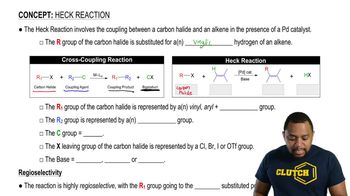
Heck Reaction Mechanism

Functional Groups

Functional groups are specific groups of atoms within molecules that are responsible for the characteristic chemical reactions of those molecules. Recognizing functional groups allows chemists to predict how different compounds will react under various conditions. This knowledge is essential for determining the major products of reactions, as different functional groups can lead to different pathways and outcomes.
추천 영상:
02:36
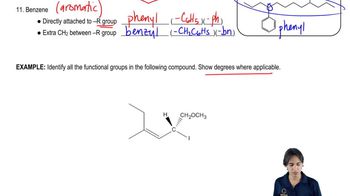
Identifying Functional Groups

Regioselectivity and Stereoselectivity

Regioselectivity refers to the preference of a chemical reaction to yield one structural isomer over others, while stereoselectivity involves the preference for one stereoisomer over another. These concepts are important for predicting the major products of reactions, especially in cases where multiple products are possible. Understanding these selectivities helps in rationalizing the outcome of reactions based on the stability of the resulting products.
추천 영상:
05:09
Heck Reaction