Ch. 10 - Reactions of Alcohols, Ethers, Epoxides, Amines, and Sulfur-Containing Compounds
Bruice - Organic Chemistry 8th Edition
Bruice8th EditionOrganic ChemistryISBN: 9780135213711당신이 사용하는 게 아니라요?교과서 변경
10장, 문제 55g

What is the product of each of the following reactions?
g.

검증된 단계별 안내
1
Step 1: Identify the reactants and reagents. The reactant is a secondary alcohol (CH3CH(CH3)CH2OH), and the reagents are thionyl chloride (SOCl2) and pyridine.
Step 2: Understand the role of SOCl2 and pyridine. SOCl2 is commonly used to convert alcohols into alkyl chlorides via a substitution reaction. Pyridine acts as a base to neutralize the HCl formed during the reaction.
Step 3: Predict the mechanism. The reaction proceeds via nucleophilic substitution (SN2 or SN1 depending on the alcohol type). For secondary alcohols, the mechanism typically involves the formation of an intermediate where the hydroxyl group is replaced by a chlorine atom.
Step 4: Replace the hydroxyl group (-OH) with a chlorine atom (-Cl). The product will be CH3CH(CH3)CH2Cl, where the secondary alcohol is converted into a secondary alkyl chloride.
Step 5: Verify stereochemistry if applicable. Since the starting alcohol is not chiral, stereochemistry is not a concern in this case. The product is a simple alkyl chloride.

비슷한 문제에 대한 검증된 영상 답변:

이 영상 해법은 위 문제에 도움이 된다고 튜터들이 추천한 것입니다.

주요 개념

질문에 올바르게 답하기 위해 반드시 이해해야 하는 핵심 개념들은 다음과 같습니다.

Reaction Mechanisms

Understanding reaction mechanisms is crucial in organic chemistry as they describe the step-by-step process by which reactants transform into products. This includes identifying intermediates, transition states, and the movement of electrons. Familiarity with mechanisms helps predict the outcome of reactions and the stability of products formed.
추천 영상:
02:16
Heck Reaction Mechanism

Functional Groups

Functional groups are specific groups of atoms within molecules that are responsible for the characteristic chemical reactions of those molecules. Recognizing functional groups allows chemists to predict reactivity and the types of reactions that can occur. Common functional groups include alcohols, carboxylic acids, and amines, each influencing the behavior of the molecule in reactions.
추천 영상:
02:36
Identifying Functional Groups

Stereochemistry

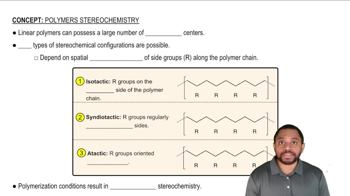
Stereochemistry involves the study of the spatial arrangement of atoms in molecules and how this affects their chemical behavior. Isomers, which are compounds with the same molecular formula but different arrangements, can exhibit different properties and reactivities. Understanding stereochemistry is essential for predicting the products of reactions, especially in cases involving chiral centers.
추천 영상:
가이드 코스
1:38
Polymer Stereochemistry Concept 1