Ch. 10 - Reactions of Alcohols, Ethers, Epoxides, Amines, and Sulfur-Containing Compounds
Bruice - Organic Chemistry 8th Edition
Bruice8th EditionOrganic ChemistryISBN: 9780135213711당신이 사용하는 게 아니라요?교과서 변경
10장, 문제 8a

What stereoisomers does the following reaction form?

검증된 단계별 안내
1
Step 1: Analyze the given structure. The molecule contains a secondary alcohol (-OH group) attached to a chiral carbon. The reaction involves HCl and heat, which suggests a substitution reaction where the hydroxyl group is replaced by a chloride ion.
Step 2: Understand the mechanism. The reaction likely proceeds via an SN1 mechanism due to the secondary alcohol and the presence of heat. In an SN1 reaction, the hydroxyl group is protonated by HCl, forming water as a leaving group. This generates a carbocation intermediate.
Step 3: Consider the stereochemistry of the carbocation intermediate. The carbocation formed is planar (sp2 hybridized), meaning it can be attacked by the chloride ion from either side, leading to the formation of two stereoisomers (R and S configurations).
Step 4: Predict the products. Since the chloride ion can attack from either side of the planar carbocation, the reaction forms a racemic mixture of the two stereoisomers.
Step 5: Summarize the stereoisomers formed. The reaction produces two stereoisomers: one with the R configuration and one with the S configuration at the chiral center where the chloride is attached.

비슷한 문제에 대한 검증된 영상 답변:

이 영상 해법은 위 문제에 도움이 된다고 튜터들이 추천한 것입니다.
영상 길이:
6m

주요 개념

질문에 올바르게 답하기 위해 반드시 이해해야 하는 핵심 개념들은 다음과 같습니다.

Stereoisomerism

Stereoisomerism refers to the phenomenon where compounds have the same molecular formula and connectivity of atoms but differ in the spatial arrangement of those atoms. This can lead to different physical and chemical properties. The two main types of stereoisomers are enantiomers, which are non-superimposable mirror images, and diastereomers, which are not mirror images of each other.
추천 영상:
01:58
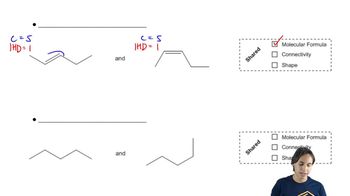
Determining when molecules are stereoisomers.

Chirality

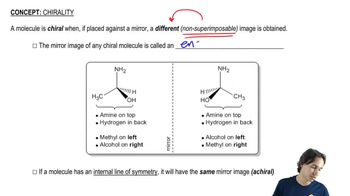
Chirality is a property of a molecule that makes it non-superimposable on its mirror image, much like left and right hands. A chiral center, typically a carbon atom bonded to four different substituents, is crucial for the formation of enantiomers. Understanding chirality is essential for predicting the stereoisomers produced in a reaction, as it influences the spatial arrangement of atoms.
추천 영상:
05:10
What is chirality?

Reaction Mechanism

A reaction mechanism describes the step-by-step process by which reactants are converted into products, including the formation and breaking of bonds. It provides insight into the intermediates and transition states involved in the reaction. Analyzing the mechanism is vital for determining the stereochemical outcomes, as it can reveal how stereocenters are created or altered during the reaction.
추천 영상:
02:16
Heck Reaction Mechanism