
Ch. 11 - Organometallic Compounds
Bruice - Organic Chemistry 8th Edition
Bruice8th EditionOrganic ChemistryISBN: 9780135213711당신이 사용하는 게 아니라요?교과서 변경
11장, 문제 57a(6)

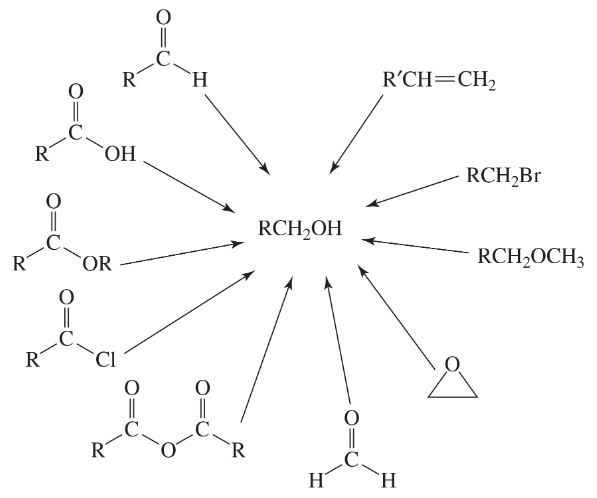
a. Show the reagents required to form the primary alcohol in each of the following reactions.

검증된 단계별 안내
1
Step 1: Identify the starting material and the product. The starting material is an aldehyde (ethanal, CH₃CHO), and the product is a primary alcohol (ethanol, CH₃CH₂OH).
Step 2: Recognize the type of reaction. This is a reduction reaction where the aldehyde is reduced to a primary alcohol.
Step 3: Select the appropriate reducing agent. Common reducing agents for this transformation include sodium borohydride (NaBH₄) or lithium aluminum hydride (LiAlH₄).
Step 4: Consider the reaction conditions. NaBH₄ is typically used in protic solvents like ethanol or water, while LiAlH₄ requires anhydrous conditions and is often used in ether solvents such as diethyl ether.
Step 5: Write the reaction mechanism. The reducing agent donates hydride ions (H⁻) to the carbonyl carbon of the aldehyde, breaking the C=O double bond and forming the primary alcohol.

비슷한 문제에 대한 검증된 영상 답변:

이 영상 해법은 위 문제에 도움이 된다고 튜터들이 추천한 것입니다.
영상 길이:
4m

주요 개념

질문에 올바르게 답하기 위해 반드시 이해해야 하는 핵심 개념들은 다음과 같습니다.

Carbonyl Compounds

Carbonyl compounds contain a carbon atom double-bonded to an oxygen atom (C=O). They are classified into aldehydes and ketones, depending on the carbonyl's position in the molecule. Aldehydes, like the one shown in the reaction, have at least one hydrogen atom attached to the carbonyl carbon, making them more reactive in nucleophilic addition reactions.
추천 영상:
01:40
Defining meso compounds.

Nucleophilic Addition

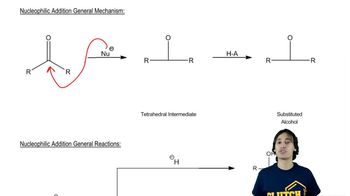
Nucleophilic addition is a fundamental reaction mechanism in organic chemistry where a nucleophile attacks an electrophilic carbon atom, such as that in a carbonyl group. This reaction typically leads to the formation of alcohols when the carbonyl compound is reduced. In the context of the question, a nucleophile will add to the carbonyl carbon, resulting in the formation of a primary alcohol.
추천 영상:
08:27
Nucleophilic Addition

Reagents for Alcohol Formation

To convert a carbonyl compound into a primary alcohol, specific reagents are required. Commonly, lithium aluminum hydride (LiAlH4) or sodium borohydride (NaBH4) are used as reducing agents. These reagents donate hydride ions (H-) to the carbonyl carbon, effectively reducing it and resulting in the formation of a primary alcohol.
추천 영상:
01:52
Reagents