Ch. 12 - Radicals
Bruice - Organic Chemistry 8th Edition
Bruice8th EditionOrganic ChemistryISBN: 9780135213711당신이 사용하는 게 아니라요?교과서 변경
12장, 문제 39e

What alkyl halide will be obtained in greatest yield? Ignore stereoisomers.
e.

검증된 단계별 안내
1
Step 1: Recognize that the reaction involves HBr in the presence of peroxide. This indicates that the reaction will follow the anti-Markovnikov addition mechanism due to the radical pathway initiated by the peroxide.
Step 2: Analyze the structure of the alkene in each case. In the first image, the alkene is part of a cyclohexene ring with a methyl substituent. In the second image, the alkene is part of a cyclohexene ring with a vinyl group and a methyl substituent.
Step 3: Determine the site of radical formation. The anti-Markovnikov addition mechanism involves the bromine radical adding to the less substituted carbon of the double bond, forming the most stable radical intermediate.
Step 4: Predict the major product for each case. In the first image, the bromine will add to the less substituted carbon of the double bond, resulting in the formation of a bromocyclohexane derivative. In the second image, the bromine will add to the less substituted carbon of the double bond in the vinyl group, resulting in a bromocyclohexane derivative with a vinyl substituent.
Step 5: Compare the stability of the radical intermediates and steric effects to determine which alkyl halide will be obtained in the greatest yield. The product with the most stable radical intermediate and least steric hindrance will be favored.

비슷한 문제에 대한 검증된 영상 답변:

이 영상 해법은 위 문제에 도움이 된다고 튜터들이 추천한 것입니다.
영상 길이:
1m

주요 개념

질문에 올바르게 답하기 위해 반드시 이해해야 하는 핵심 개념들은 다음과 같습니다.

Alkyl Halides

Alkyl halides are organic compounds derived from alkanes by replacing one or more hydrogen atoms with halogen atoms (such as fluorine, chlorine, bromine, or iodine). They are classified based on the type of carbon atom to which the halogen is attached: primary, secondary, or tertiary. The structure of the alkyl halide significantly influences its reactivity and the types of reactions it can undergo.
추천 영상:
01:52
How to name alkyl halides

Nucleophilic Substitution Reactions

Nucleophilic substitution reactions involve the replacement of a leaving group (like a halogen) by a nucleophile. The mechanism can follow either an SN1 or SN2 pathway, depending on the structure of the alkyl halide and the conditions of the reaction. Understanding these mechanisms is crucial for predicting which alkyl halide will be formed in greater yield, as they dictate the rate and outcome of the reaction.
추천 영상:
01:47
Nucleophiles and Electrophiles can react in Substitution Reactions.

Reaction Conditions and Yield

The yield of a reaction refers to the amount of product formed compared to the theoretical maximum. Factors such as steric hindrance, solvent effects, and temperature can influence the yield of alkyl halides in nucleophilic substitution reactions. Analyzing these conditions helps determine which alkyl halide will be produced in the greatest yield, as certain structures may favor more efficient pathways.
추천 영상:
04:37
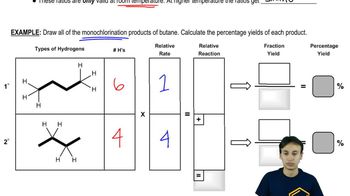
Draw all of the monochlorination products and calculate percentage yields.