
Ch. 12 - Radicals
Bruice - Organic Chemistry 8th Edition
Bruice8th EditionOrganic ChemistryISBN: 9780135213711당신이 사용하는 게 아니라요?교과서 변경
12장, 문제 31b

What is the major product of the following reactions? Disregard stereoisomers:
b.

검증된 단계별 안내
1
Step 1: Recognize the reagents and conditions. NBS (N-Bromosuccinimide) is used for allylic or benzylic bromination in the presence of a radical initiator, such as peroxide and heat.
Step 2: Identify the allylic position in the molecule. The allylic position is the carbon atom adjacent to the double bond in the cyclopentene structure.
Step 3: Understand the mechanism. The reaction proceeds via a radical mechanism. Peroxide and heat generate radicals, which abstract a hydrogen atom from the allylic position, forming an allylic radical.
Step 4: Bromine from NBS reacts with the allylic radical to form the major product. The bromine atom attaches to the allylic position, resulting in an allylic bromide.
Step 5: Consider resonance stabilization. The allylic radical is resonance-stabilized, so bromination can occur at either of the two equivalent allylic positions. Disregard stereoisomers as instructed.

비슷한 문제에 대한 검증된 영상 답변:

이 영상 해법은 위 문제에 도움이 된다고 튜터들이 추천한 것입니다.
영상 길이:
2m

주요 개념

질문에 올바르게 답하기 위해 반드시 이해해야 하는 핵심 개념들은 다음과 같습니다.

Reaction Mechanisms

Understanding reaction mechanisms is crucial in organic chemistry as they describe the step-by-step process by which reactants transform into products. This includes identifying intermediates, transition states, and the movement of electrons. Familiarity with mechanisms helps predict the major products of reactions based on the stability of intermediates and the energy changes involved.
추천 영상:
02:16
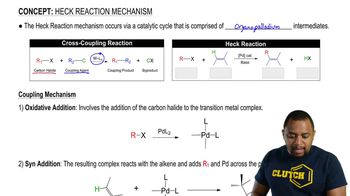
Heck Reaction Mechanism

Functional Groups

Functional groups are specific groups of atoms within molecules that are responsible for the characteristic chemical reactions of those molecules. Recognizing functional groups allows chemists to predict how a compound will react in a given reaction. Different functional groups can influence the reactivity and the type of products formed during chemical reactions.
추천 영상:
02:36
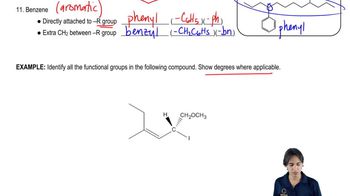
Identifying Functional Groups

Regioselectivity

Regioselectivity refers to the preference of a chemical reaction to occur at one location over another in a molecule. This concept is essential for predicting the major product of a reaction, as certain pathways may lead to more stable or favorable products. Understanding regioselectivity helps in determining which isomer will be formed when multiple possibilities exist.
추천 영상:
05:09
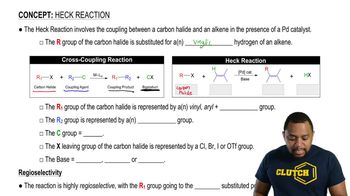
Heck Reaction