Ch. 13 - Mass Spectrometry; Infrared Spectroscopy; UV/Vis Spectroscopy
Bruice - Organic Chemistry 8th Edition
Bruice8th EditionOrganic ChemistryISBN: 9780135213711당신이 사용하는 게 아니라요?교과서 변경
13장, 문제 50

A mass spectrum shows significant peaks at m/z = 87, 115, 140, and 143. Which of the following compounds is responsible for that mass spectrum?

검증된 단계별 안내
1
Analyze the given m/z values (87, 115, 140, and 143) and consider that these represent the mass-to-charge ratios of fragments in the mass spectrum. Each peak corresponds to a fragment of the molecule, so the task is to deduce the structure of the compound that could produce these fragments.
Determine the molecular formula or structure of the possible compounds provided in the question. If no compounds are explicitly listed, consider common organic molecules that could produce fragments with these m/z values.
For each m/z value, calculate the possible fragment that could correspond to it. For example, m/z = 87 could correspond to a fragment such as C6H11+ (calculated as 6 carbons × 12 + 11 hydrogens × 1 = 87). Repeat this process for m/z = 115, 140, and 143.
Compare the calculated fragments to the possible fragmentation patterns of the candidate compounds. Consider common fragmentation mechanisms such as cleavage at weak bonds, loss of small neutral molecules (e.g., H2O, CO2), or rearrangements.
Match the fragmentation pattern of the compound that best explains all the observed m/z values. The compound whose fragmentation produces peaks at m/z = 87, 115, 140, and 143 is the one responsible for the given mass spectrum.

비슷한 문제에 대한 검증된 영상 답변:

이 영상 해법은 위 문제에 도움이 된다고 튜터들이 추천한 것입니다.
영상 길이:
5m

주요 개념

질문에 올바르게 답하기 위해 반드시 이해해야 하는 핵심 개념들은 다음과 같습니다.

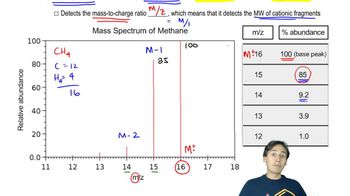
Mass Spectrometry

Mass spectrometry is an analytical technique used to measure the mass-to-charge ratio of ions. It provides information about the molecular weight and structure of compounds by generating a mass spectrum, which displays the relative abundance of ions at different mass-to-charge (m/z) values. Understanding how to interpret these peaks is crucial for identifying compounds based on their molecular weights.
추천 영상:
01:25
How to Read a Mass Spectrum

Isotopic Patterns

Isotopic patterns refer to the distribution of isotopes of an element in a compound, which can affect the mass spectrum. For example, elements like carbon and chlorine have naturally occurring isotopes that can create additional peaks in the spectrum. Recognizing these patterns helps in deducing the molecular formula and structure of the compound responsible for the observed peaks.
추천 영상:
08:06
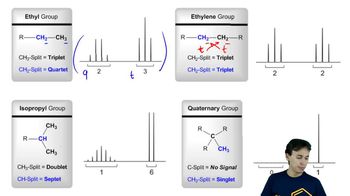
Common Splitting Patterns

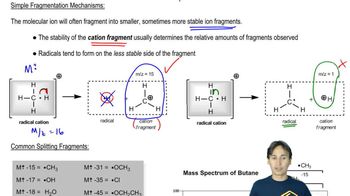
Fragmentation

Fragmentation is the process by which a molecule breaks apart into smaller ions during mass spectrometry. The resulting fragments can provide insights into the structure of the original compound. Analyzing the m/z values of these fragments allows chemists to piece together the molecular structure and identify the compound that produced the mass spectrum.
추천 영상:
12:08
Simple Fragmentation Mechanisms