Ch. 13 - Mass Spectrometry; Infrared Spectroscopy; UV/Vis Spectroscopy
Bruice - Organic Chemistry 8th Edition
Bruice8th EditionOrganic ChemistryISBN: 9780135213711당신이 사용하는 게 아니라요?교과서 변경
13장, 문제 45i,j

For each of the following pairs of compounds, identify one IR absorption band that could be used to distinguish between them:
i.
j.

검증된 단계별 안내
1
Step 1: Analyze the first pair of compounds (I). The first compound contains a double bond (alkene), while the second compound contains a triple bond (alkyne). In IR spectroscopy, alkenes typically show a C=C stretching vibration around 1600-1680 cm⁻¹, whereas alkynes exhibit a C≡C stretching vibration around 2100-2260 cm⁻¹. These distinct absorption bands can be used to differentiate between the two compounds.
Step 2: For the second pair of compounds (II), the first compound is an aldehyde, and the second compound is a ketone. Aldehydes exhibit a characteristic C-H stretching vibration near 2720-2820 cm⁻¹, which is absent in ketones. Both compounds will show a C=O stretching vibration, typically around 1700 cm⁻¹, but the aldehyde's unique C-H stretch can be used to distinguish it from the ketone.
Step 3: Understand the functional group differences in each pair. IR spectroscopy is particularly useful for identifying functional groups because each type of bond absorbs infrared light at a specific frequency.
Step 4: When analyzing IR spectra, focus on the regions where the functional group vibrations occur. For example, the alkene and alkyne regions are distinct, as are the aldehyde and ketone regions.
Step 5: Use the IR absorption bands mentioned above to identify the compounds in practice. Ensure that the sample is prepared correctly and the IR spectrum is interpreted accurately to confirm the presence of the distinguishing functional groups.

비슷한 문제에 대한 검증된 영상 답변:

이 영상 해법은 위 문제에 도움이 된다고 튜터들이 추천한 것입니다.
영상 길이:
5m

주요 개념

질문에 올바르게 답하기 위해 반드시 이해해야 하는 핵심 개념들은 다음과 같습니다.

Infrared (IR) Spectroscopy

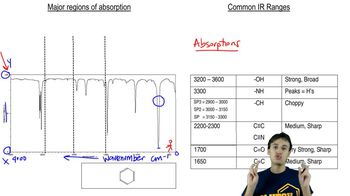
Infrared spectroscopy is a technique used to identify functional groups in organic compounds by measuring the absorption of infrared light. Different bonds absorb characteristic frequencies of IR radiation, leading to distinct absorption bands in the IR spectrum. This allows chemists to determine the presence of specific functional groups based on their unique absorption patterns.
추천 영상:
16:04
General Features of IR Spect

Functional Groups

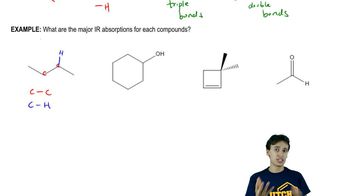
Functional groups are specific groups of atoms within molecules that are responsible for the characteristic chemical reactions of those molecules. In the context of IR spectroscopy, different functional groups, such as alcohols, carbonyls, and alkenes, exhibit unique absorption bands that can be used to distinguish between compounds. Recognizing these groups is essential for interpreting IR spectra.
추천 영상:
02:36
Identifying Functional Groups

Distinguishing Absorption Bands

Distinguishing absorption bands in IR spectroscopy involves identifying specific peaks in the spectrum that correspond to different functional groups or structural features of the compounds being analyzed. For example, the presence of a carbonyl (C=O) group typically shows a strong absorption around 1700 cm-1, while an alcohol (O-H) shows a broad absorption around 3200-3600 cm-1. These unique bands help differentiate between similar compounds.
추천 영상:
02:02
Major IR absorptions