Ch. 13 - Mass Spectrometry; Infrared Spectroscopy; UV/Vis Spectroscopy
Bruice - Organic Chemistry 8th Edition
Bruice8th EditionOrganic ChemistryISBN: 9780135213711당신이 사용하는 게 아니라요?교과서 변경
13장, 문제 72a

How can you use UV spectroscopy to distinguish between the compounds in each of the following pairs?
a. Two chemical structures are shown side by side, separated by the word "and."

검증된 단계별 안내
1
Step 1: Analyze the structures of compounds A and B. Compound A contains conjugated double bonds (a system of alternating single and double bonds), while compound B has isolated double bonds (double bonds separated by single bonds without conjugation). This structural difference is key to their UV spectroscopy behavior.
Step 2: Understand the principle of UV spectroscopy. UV spectroscopy measures the absorption of ultraviolet light by molecules, which is influenced by the presence of conjugated systems. Conjugated systems lower the energy gap between the HOMO (highest occupied molecular orbital) and LUMO (lowest unoccupied molecular orbital), resulting in absorption at longer wavelengths.
Step 3: Predict the UV absorption behavior. Compound A, with its conjugated double bonds, will absorb UV light at a longer wavelength (lower energy) compared to compound B, which has isolated double bonds. This is because conjugation increases the delocalization of π-electrons, stabilizing the molecule and shifting the absorption maximum (λmax) to a longer wavelength.
Step 4: Compare the λmax values. In a UV spectrum, compound A will show a λmax at a longer wavelength due to its conjugated system, while compound B will have a λmax at a shorter wavelength because its double bonds are not conjugated.
Step 5: Use UV spectroscopy data to distinguish the compounds. By recording the UV spectra of both compounds, you can identify compound A by its longer λmax and compound B by its shorter λmax. This difference in absorption wavelengths provides a clear method to differentiate between the two compounds.

비슷한 문제에 대한 검증된 영상 답변:

이 영상 해법은 위 문제에 도움이 된다고 튜터들이 추천한 것입니다.
영상 길이:
2m

주요 개념

질문에 올바르게 답하기 위해 반드시 이해해야 하는 핵심 개념들은 다음과 같습니다.

UV Spectroscopy Principles

UV spectroscopy is a technique that measures the absorption of ultraviolet light by molecules. When a molecule absorbs UV light, electrons are excited from a ground state to a higher energy state. The specific wavelengths of light absorbed can provide information about the electronic structure of the molecule, allowing for differentiation between compounds based on their functional groups and conjugation.
추천 영상:
가이드 코스
2:56
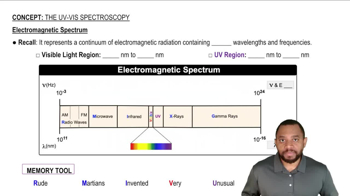
The UV-Vis Spectroscopy Concept 1

Conjugation and Electron Delocalization

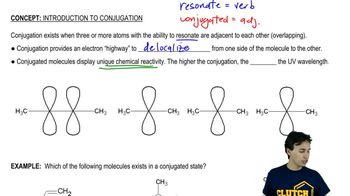
Conjugation refers to the overlap of p-orbitals across adjacent double bonds or lone pairs, allowing for electron delocalization. This delocalization lowers the energy gap between the ground and excited states, resulting in absorption of longer wavelengths (lower energy) of UV light. Compounds with different degrees of conjugation will absorb UV light at different wavelengths, making it a key factor in distinguishing between them.
추천 영상:
05:29
Definition of Conjugation

Functional Groups and Their UV Absorption

Different functional groups absorb UV light at characteristic wavelengths due to their unique electronic structures. For example, alkenes and aromatic compounds typically show distinct absorption patterns. By analyzing the UV absorption spectrum, one can identify specific functional groups present in the compounds, aiding in their differentiation based on the observed peaks in the spectrum.
추천 영상:
02:36
Identifying Functional Groups