Ch. 13 - Mass Spectrometry; Infrared Spectroscopy; UV/Vis Spectroscopy
Bruice - Organic Chemistry 8th Edition
Bruice8th EditionOrganic ChemistryISBN: 9780135213711당신이 사용하는 게 아니라요?교과서 변경
13장, 문제 31

Which of the following compounds has a vibration that is infrared inactive?
1-butyne, 2-butyne, H2, H2O, Cl2, ethene

검증된 단계별 안내
1
Step 1: Understand the concept of infrared (IR) activity. A vibration is IR active if it results in a change in the dipole moment of the molecule. Molecules or bonds that do not exhibit a change in dipole moment during vibration are IR inactive.
Step 2: Analyze the molecular structure of 1-butyne. It is a terminal alkyne with the structure CH≡C-CH2-CH3. The C≡C bond in 1-butyne is polar, and its stretching vibration will cause a change in dipole moment, making it IR active.
Step 3: Analyze the molecular structure of 2-butyne. It is an internal alkyne with the structure CH3-C≡C-CH3. The C≡C bond in 2-butyne is symmetric, and its stretching vibration does not cause a change in dipole moment, making it IR inactive.
Step 4: Analyze the molecular structure of H2. It is a diatomic molecule with a nonpolar covalent bond. Since there is no dipole moment in H2, its vibrations do not cause a change in dipole moment, making it IR inactive.
Step 5: Compare the compounds. Based on the analysis, 2-butyne and H2 are IR inactive, while 1-butyne is IR active. The key factor is whether the vibration causes a change in dipole moment.

비슷한 문제에 대한 검증된 영상 답변:

이 영상 해법은 위 문제에 도움이 된다고 튜터들이 추천한 것입니다.
영상 길이:
7m

주요 개념

질문에 올바르게 답하기 위해 반드시 이해해야 하는 핵심 개념들은 다음과 같습니다.

Infrared Activity

Infrared activity refers to the ability of a molecule to absorb infrared radiation, which is determined by changes in the dipole moment during molecular vibrations. For a compound to be infrared active, it must have a permanent dipole moment or undergo a change in dipole moment during vibration. Molecules that are symmetrical or nonpolar often exhibit infrared inactivity.
추천 영상:
가이드 코스
4:47
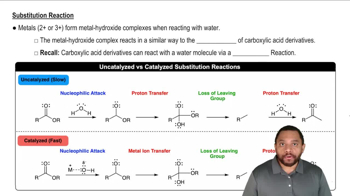
Metal Ion Catalysis: Water Activation Concept 2

Molecular Symmetry

Molecular symmetry plays a crucial role in determining infrared activity. Symmetrical molecules, such as H2, do not have a permanent dipole moment and do not exhibit vibrations that change the dipole moment, making them infrared inactive. Understanding the symmetry of a molecule helps predict its vibrational modes and their infrared activity.
추천 영상:
00:25
Determining Chirality with Plane of Symmetry

Types of Hydrocarbons

Hydrocarbons can be classified into alkanes, alkenes, and alkynes, each with distinct structural features. 1-butyne and 2-butyne are alkynes, which contain triple bonds and can exhibit different vibrational characteristics. Recognizing the type of hydrocarbon and its structure is essential for analyzing its infrared activity and understanding how molecular vibrations relate to functional groups.
추천 영상:
04:52
Aromaticity of Hydrocarbons