Ch. 14 - NMR Spectroscopy
Bruice - Organic Chemistry 8th Edition
Bruice8th EditionOrganic ChemistryISBN: 9780135213711당신이 사용하는 게 아니라요?교과서 변경
14장, 문제 24

Explain the relative chemical shifts of the benzene ring protons in Figure 14.18.
<IMAGE>

검증된 단계별 안내
1
Identify the structure in the image: The molecule is a substituted benzene ring with an -OH group attached to one of the carbons. The protons on the benzene ring are labeled as 'a', 'b', and 'c'.
Understand the concept of chemical shifts: In NMR spectroscopy, chemical shifts are influenced by the electronic environment around the protons. Electron-withdrawing or electron-donating groups attached to the benzene ring affect the deshielding or shielding of nearby protons.
Analyze the effect of the -OH group: The -OH group is an electron-donating group through resonance. It increases electron density on the benzene ring, particularly at the ortho and para positions relative to the -OH group. This affects the chemical shifts of the protons labeled 'a', 'b', and 'c'.
Explain the relative shifts: Protons 'a' are ortho to the -OH group and experience increased electron density due to resonance, making them more shielded and causing their chemical shift to be upfield (lower ppm). Protons 'b' are meta to the -OH group and are less affected by the electron-donating effect, resulting in a chemical shift that is slightly downfield compared to 'a'. Proton 'c' is para to the -OH group and experiences moderate shielding due to resonance, leading to a chemical shift that is intermediate between 'a' and 'b'.
Summarize the reasoning: The relative chemical shifts of the benzene ring protons are determined by their positions relative to the electron-donating -OH group. Protons 'a' are the most shielded (upfield), followed by 'c', and then 'b', which is the least shielded (downfield).

비슷한 문제에 대한 검증된 영상 답변:

이 영상 해법은 위 문제에 도움이 된다고 튜터들이 추천한 것입니다.
영상 길이:
7m

주요 개념

질문에 올바르게 답하기 위해 반드시 이해해야 하는 핵심 개념들은 다음과 같습니다.

Chemical Shifts in NMR Spectroscopy

Chemical shifts in NMR spectroscopy refer to the resonance frequency of a nucleus relative to a standard in a magnetic field. They are influenced by the electronic environment surrounding the nucleus, which can be affected by factors such as electronegativity, hybridization, and molecular symmetry. In aromatic compounds like benzene, protons experience different shifts due to the delocalized π-electrons, leading to distinct signals for each type of hydrogen.
추천 영상:
11:44
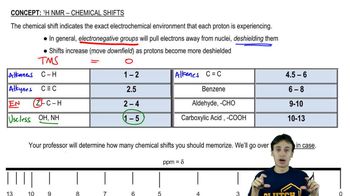
1H NMR Chemical Shifts

Aromaticity and Its Effects

Aromaticity is a property of cyclic compounds that have a planar structure, complete delocalization of π-electrons, and follow Huckel's rule (4n + 2 π-electrons). This delocalization stabilizes the molecule and affects the chemical shifts of protons in the benzene ring. The protons on the benzene ring will resonate at different frequencies based on their positions relative to substituents and the overall electron density in the ring.
추천 영상:
08:19
Intro to Aromaticity

Substituent Effects on Proton Shifts

The presence of substituents on a benzene ring can significantly influence the chemical shifts of the protons. Electron-withdrawing groups (EWGs) can deshield protons, causing them to resonate at lower fields (higher ppm), while electron-donating groups (EDGs) can shield protons, resulting in higher field shifts (lower ppm). Understanding these effects is crucial for interpreting NMR spectra and predicting the relative positions of signals for different protons in substituted benzene derivatives.
추천 영상:
가이드 코스
2:02
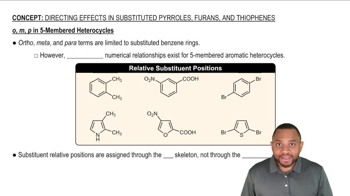
Directing Effects in Substituted Pyrroles, Furans, and Thiophenes Concept 1