Ch. 14 - NMR Spectroscopy
Bruice - Organic Chemistry 8th Edition
Bruice8th EditionOrganic ChemistryISBN: 9780135213711당신이 사용하는 게 아니라요?교과서 변경
14장, 문제 4a,b

How many signals would you expect to see in the 1H NMR spectrum of each of the following compounds?
a. CH3CH2CH2CH3
b. BrCH2CH2Br

검증된 단계별 안내
1
Step 1: Understand the concept of 1H NMR spectroscopy. In 1H NMR, the number of signals corresponds to the number of unique proton environments in the molecule. Protons in identical chemical environments (chemically equivalent protons) will produce the same signal.
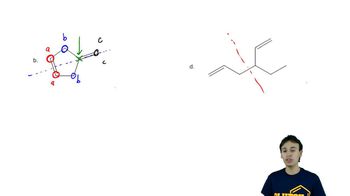
Step 2: Analyze the symmetry of the molecule. Symmetry can help identify equivalent protons. For example, if a molecule has a plane of symmetry, protons on either side of the plane that are in the same environment will be equivalent.
Step 3: Identify the different types of protons in the molecule. Look for protons attached to different functional groups, protons in different electronic environments, or protons in different spatial positions (e.g., axial vs. equatorial in cyclohexane).
Step 4: Count the unique proton environments. Assign each unique environment a separate signal. For example, in a molecule like CH3-CH2-OH, the CH3, CH2, and OH groups are in different environments and will produce three distinct signals.
Step 5: Repeat the process for each compound (a and b). Carefully examine the structure of each compound to determine the number of unique proton environments and, therefore, the number of expected signals in the 1H NMR spectrum.

비슷한 문제에 대한 검증된 영상 답변:

이 영상 해법은 위 문제에 도움이 된다고 튜터들이 추천한 것입니다.
영상 길이:
6m

주요 개념

질문에 올바르게 답하기 위해 반드시 이해해야 하는 핵심 개념들은 다음과 같습니다.

Nuclear Magnetic Resonance (NMR) Spectroscopy

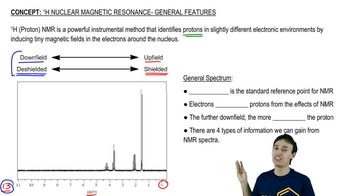
NMR spectroscopy is a powerful analytical technique used to determine the structure of organic compounds. It relies on the magnetic properties of certain nuclei, primarily hydrogen (1H), to provide information about the number and environment of hydrogen atoms in a molecule. The resulting spectrum displays signals that correspond to different hydrogen environments, allowing chemists to infer structural details.
추천 영상:
10:06
General NMR Features

Chemical Shifts

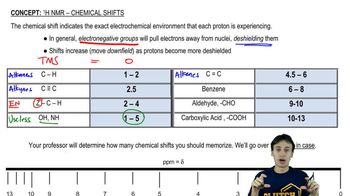
Chemical shifts in NMR refer to the variation in resonance frequency of nuclei due to their electronic environment. Different functional groups and molecular structures influence the local magnetic field experienced by hydrogen atoms, leading to distinct chemical shift values. Understanding these shifts is crucial for interpreting the NMR spectrum and identifying the types of hydrogen present in a compound.
추천 영상:
11:44
1H NMR Chemical Shifts

Signal Multiplicity

Signal multiplicity in NMR arises from the splitting of signals due to spin-spin coupling between neighboring hydrogen atoms. This phenomenon provides insight into the number of adjacent hydrogens, which can help deduce the connectivity and arrangement of atoms in a molecule. Recognizing patterns of singlets, doublets, triplets, and more is essential for accurately analyzing the NMR spectrum.
추천 영상:
02:02
Identifying Proton Signals