Ch. 15 - Reactions of Carboxylic Acids and Carboxylic Acid Derivatives
Bruice - Organic Chemistry 8th Edition
Bruice8th EditionOrganic ChemistryISBN: 9780135213711당신이 사용하는 게 아니라요?교과서 변경
15장, 문제 78

a. A student did not obtain any ester when he added 2,4,6-trimethylbenzoic acid to an acidic solution of ethanol. Why? (HINT: Build models.)
b. Would he have encountered the same problem if he had tried to synthesize the methyl ester of 4-methylbenzoic acid in the same way?

검증된 단계별 안내
1
Step 1: Understand the reaction mechanism for esterification. Esterification is typically carried out by reacting a carboxylic acid with an alcohol in the presence of an acid catalyst. The reaction proceeds via a nucleophilic attack of the alcohol on the carbonyl carbon of the carboxylic acid, followed by the elimination of water.
Step 2: Analyze the structure of 2,4,6-trimethylbenzoic acid. This compound has three bulky methyl groups attached to the benzene ring at positions 2, 4, and 6. These groups create significant steric hindrance around the carboxylic acid group, making it difficult for the ethanol molecule to approach and react with the carbonyl carbon.
Step 3: Consider the role of steric hindrance in the reaction. The steric hindrance caused by the bulky methyl groups prevents the nucleophilic ethanol from effectively attacking the carbonyl carbon of the carboxylic acid. As a result, the esterification reaction does not proceed, and no ester is formed.
Step 4: Compare this to 4-methylbenzoic acid. In this compound, there is only one methyl group at the 4-position of the benzene ring. This single methyl group does not create significant steric hindrance around the carboxylic acid group, allowing the ethanol to approach and react with the carbonyl carbon more easily.
Step 5: Conclude that the student would not encounter the same problem with 4-methylbenzoic acid. The reduced steric hindrance in this case would allow the esterification reaction to proceed, resulting in the formation of the methyl ester.

비슷한 문제에 대한 검증된 영상 답변:

이 영상 해법은 위 문제에 도움이 된다고 튜터들이 추천한 것입니다.
영상 길이:
2m

주요 개념

질문에 올바르게 답하기 위해 반드시 이해해야 하는 핵심 개념들은 다음과 같습니다.

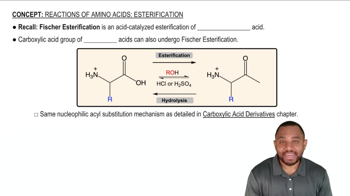
Esterification Reaction

Esterification is a chemical reaction between an alcohol and a carboxylic acid, resulting in the formation of an ester and water. This process typically requires an acid catalyst to proceed efficiently. In the case of 2,4,6-trimethylbenzoic acid and ethanol, steric hindrance from the bulky methyl groups can impede the reaction, preventing ester formation.
추천 영상:
가이드 코스
1:21
Reactions of Amino Acids: Esterification Concept 1

Steric Hindrance

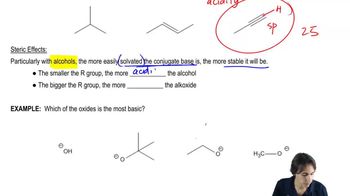
Steric hindrance refers to the prevention of reactions at a particular location within a molecule due to the size of substituent groups. In the context of 2,4,6-trimethylbenzoic acid, the three methyl groups create a crowded environment around the carboxylic acid functional group, making it difficult for the ethanol to approach and react, thus inhibiting ester formation.
추천 영상:
02:53
Understanding steric effects.

Comparison of Reactivity

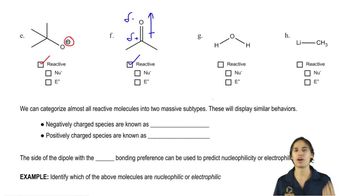
When comparing the reactivity of different carboxylic acids, the structure and substituents play a crucial role. The methyl ester of 4-methylbenzoic acid may have less steric hindrance than 2,4,6-trimethylbenzoic acid, potentially allowing for successful esterification with ethanol. Understanding how substituents affect reactivity is essential for predicting the outcomes of organic reactions.
추천 영상:
01:17
Reactivity of Molecules