Ch. 15 - Reactions of Carboxylic Acids and Carboxylic Acid Derivatives
Bruice - Organic Chemistry 8th Edition
Bruice8th EditionOrganic ChemistryISBN: 9780135213711당신이 사용하는 게 아니라요?교과서 변경
15장, 문제 29

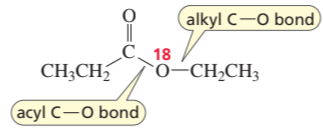
D. N. Kursanov, a Russian chemist, proved that the bond that is broken in the hydroxide-ion-promoted ­hydrolysis of an ester is the acyl C—O bond, rather than the alkyl C—O bond, by studying the hydrolysis of the following ester under basic conditions:
Diagram showing an ester with labeled acyl and alkyl C—O bonds, highlighting the O^18 label on the acyl bond.
a. What products contained the 18O label?
b. What product would have contained the 18O label if the alkyl C—O bond had broken?

검증된 단계별 안내
1
Step 1: Analyze the ester structure provided in the image. The ester contains an acyl group (C=O) and an alkyl group (CH3CH2O). The oxygen labeled with O^18 is part of the alkyl group, specifically bonded to the carbon of the ethyl group.
Step 2: Understand the mechanism of hydroxide-ion-promoted hydrolysis of esters. In basic hydrolysis, the hydroxide ion attacks the carbonyl carbon of the acyl group, leading to the cleavage of the acyl C—O bond.
Step 3: Predict the products when the acyl C—O bond breaks. The reaction produces a carboxylate ion (CH3CH2COO^-) and an alcohol (CH3CH2O^18H). The O^18 label remains in the alcohol product because the acyl C—O bond is broken.
Step 4: Consider the alternative scenario where the alkyl C—O bond breaks. If this bond were to break, the products would be CH3CH2CO^18O^- (carboxylate ion with the O^18 label) and CH3CH2OH (regular alcohol without the O^18 label).
Step 5: Summarize the findings. When the acyl C—O bond breaks, the O^18 label is found in the alcohol product. If the alkyl C—O bond had broken, the O^18 label would have been found in the carboxylate ion product.

비슷한 문제에 대한 검증된 영상 답변:

이 영상 해법은 위 문제에 도움이 된다고 튜터들이 추천한 것입니다.
영상 길이:
3m

주요 개념

질문에 올바르게 답하기 위해 반드시 이해해야 하는 핵심 개념들은 다음과 같습니다.

Ester Hydrolysis

Ester hydrolysis is a chemical reaction where an ester reacts with water to form an alcohol and a carboxylic acid. In the presence of a base, this reaction is often referred to as saponification. Understanding the mechanism of ester hydrolysis is crucial, as it involves breaking specific bonds within the ester, which can be influenced by the conditions of the reaction, such as the presence of hydroxide ions.
추천 영상:
가이드 코스
0:48
Hydrolysis of Phosphate Esters Concept 2

Bond Selectivity in Hydrolysis

In the hydrolysis of esters, the selectivity of bond cleavage is essential for determining the products formed. The acyl C—O bond is typically more susceptible to hydrolysis than the alkyl C—O bond under basic conditions. This concept is critical for understanding the experimental findings of Kursanov, as it explains why the O^18 label appears in specific products based on which bond is broken during the reaction.
추천 영상:
가이드 코스
1:00
Hydrolysis of Thioesters Concept 2

Isotope Labeling

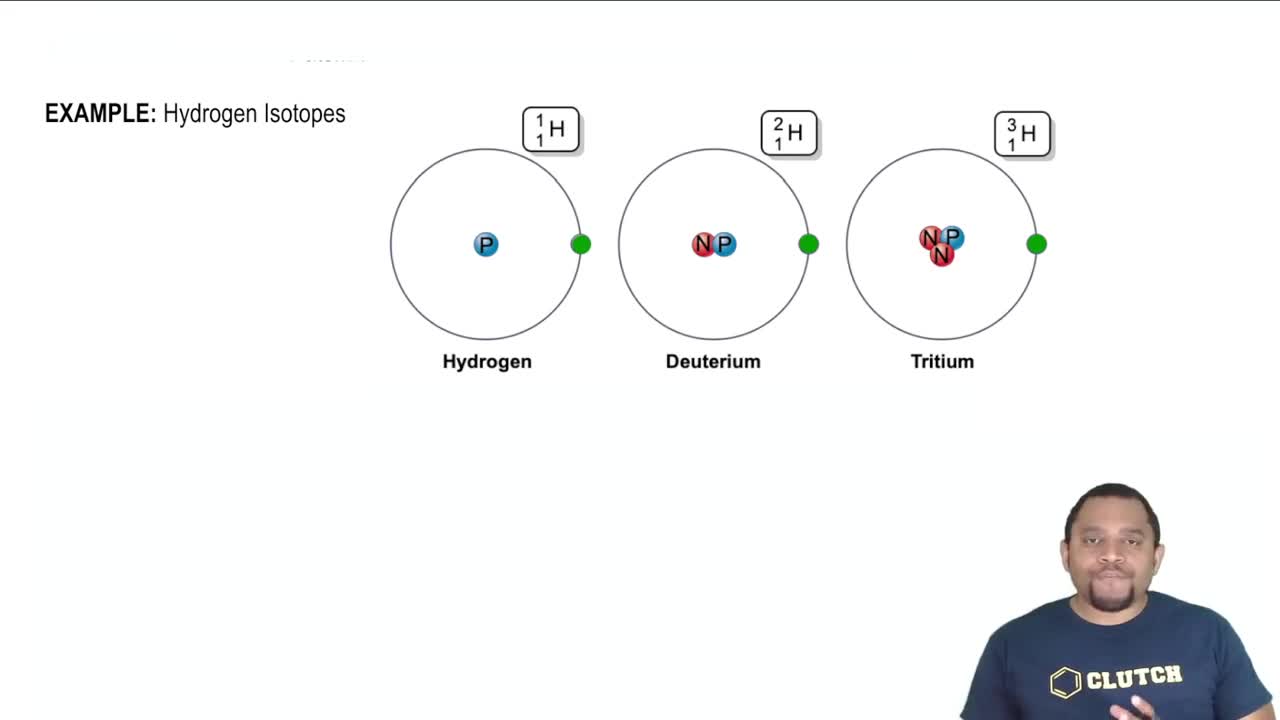
Isotope labeling involves using isotopes, such as O^18, to trace the movement of atoms through a chemical reaction. In the context of ester hydrolysis, the presence of the O^18 label in the products indicates which bond was broken during the reaction. This technique provides valuable insights into reaction mechanisms and helps chemists understand the pathways and transformations that occur during chemical processes.
추천 영상:
03:06
Understanding the hydrogen isotopes.