
Ch. 15 - Reactions of Carboxylic Acids and Carboxylic Acid Derivatives
Bruice - Organic Chemistry 8th Edition
Bruice8th EditionOrganic ChemistryISBN: 9780135213711당신이 사용하는 게 아니라요?교과서 변경
15장, 문제 82b

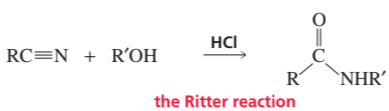
The reaction of a nitrile with an alcohol in the presence of a strong acid forms an N-substituted amide. This reaction, known as the Ritter reaction, does not work with primary alcohols.
Chemical equation illustrating the Ritter reaction: nitrile and alcohol react with HCl to form an N-substituted amide.
b. Why does the Ritter reaction not work with primary alcohols?

검증된 단계별 안내
1
The Ritter reaction involves the reaction of a nitrile (RC≡N) with an alcohol (R'OH) in the presence of a strong acid (e.g., HCl) to form an N-substituted amide (RC=O(NHR')). The mechanism relies on the formation of a carbocation intermediate from the alcohol.
In the first step of the reaction, the strong acid protonates the alcohol (R'OH), forming R'OH₂⁺. This protonated alcohol is highly unstable and loses water to generate a carbocation (R'⁺).
The stability of the carbocation is critical for the reaction to proceed. Secondary and tertiary alcohols can form stable carbocations due to hyperconjugation and inductive effects, but primary alcohols cannot form stable carbocations because primary carbocations are highly unstable and prone to rearrangement or decomposition.
Since the Ritter reaction requires a stable carbocation intermediate for the nitrile to attack, primary alcohols are not suitable substrates. The instability of the primary carbocation prevents the reaction from proceeding efficiently.
In summary, the Ritter reaction does not work with primary alcohols because the formation of a stable carbocation intermediate is not possible, which is a key step in the reaction mechanism.

비슷한 문제에 대한 검증된 영상 답변:

이 영상 해법은 위 문제에 도움이 된다고 튜터들이 추천한 것입니다.
영상 길이:
12m

주요 개념

질문에 올바르게 답하기 위해 반드시 이해해야 하는 핵심 개념들은 다음과 같습니다.

Ritter Reaction

The Ritter reaction is a chemical reaction that involves the conversion of a nitrile and an alcohol into an N-substituted amide in the presence of a strong acid, typically hydrochloric acid. This reaction is significant in organic synthesis as it allows for the formation of amides, which are important functional groups in various chemical compounds. The mechanism involves protonation of the alcohol, followed by nucleophilic attack by the nitrile.
추천 영상:
05:09
Heck Reaction

Nucleophilicity

Nucleophilicity refers to the ability of a nucleophile to donate an electron pair to an electrophile, forming a chemical bond. In the context of the Ritter reaction, the alcohol acts as a nucleophile. Primary alcohols are less nucleophilic compared to secondary or tertiary alcohols due to steric hindrance and the stability of the resulting carbocation, which affects their reactivity in this specific reaction.
추천 영상:
08:27
Nucleophilic Addition

Steric Hindrance

Steric hindrance is the prevention of reactions at a particular location in a molecule due to the size of substituent groups. In the case of primary alcohols, the steric bulk around the hydroxyl group can hinder the approach of the nitrile, making it less favorable for the nucleophilic attack necessary for the Ritter reaction. This is why primary alcohols do not effectively participate in this reaction, unlike their secondary and tertiary counterparts.
추천 영상:
02:53
Understanding steric effects.