Ch. 15 - Reactions of Carboxylic Acids and Carboxylic Acid Derivatives
Bruice - Organic Chemistry 8th Edition
Bruice8th EditionOrganic ChemistryISBN: 9780135213711당신이 사용하는 게 아니라요?교과서 변경
15장, 문제 50g,h

What compounds are formed from the reaction of benzoyl chloride with the following reagents?
g. excess benzylamine
h. 4-chlorophenol

검증된 단계별 안내
1
Identify the functional group in benzoyl chloride. Benzoyl chloride contains an acyl chloride group (-COCl), which is highly reactive and undergoes nucleophilic acyl substitution reactions.
Understand the reaction mechanism with benzylamine (excess). Benzylamine (C6H5CH2NH2) is a nucleophile that will attack the carbonyl carbon of benzoyl chloride. The reaction proceeds via a nucleophilic acyl substitution mechanism, where the amine replaces the chloride ion (Cl⁻) to form a benzamide derivative.
Write the general reaction for part (g): \( \text{C6H5COCl} + \text{C6H5CH2NH2} \rightarrow \text{C6H5CONHCH2C6H5} + \text{HCl} \). Since benzylamine is in excess, it can also neutralize the HCl formed during the reaction, preventing side reactions.
Understand the reaction mechanism with 4-chlorophenol. 4-Chlorophenol (C6H4ClOH) is a phenol derivative, and the hydroxyl group (-OH) acts as a nucleophile. It will attack the carbonyl carbon of benzoyl chloride, replacing the chloride ion (Cl⁻) to form an ester.
Write the general reaction for part (h): \( \text{C6H5COCl} + \text{C6H4ClOH} \rightarrow \text{C6H5COOC6H4Cl} + \text{HCl} \). The product is an ester (benzoyl-4-chlorophenyl ester), and HCl is released as a byproduct.

비슷한 문제에 대한 검증된 영상 답변:

이 영상 해법은 위 문제에 도움이 된다고 튜터들이 추천한 것입니다.
영상 길이:
5m

주요 개념

질문에 올바르게 답하기 위해 반드시 이해해야 하는 핵심 개념들은 다음과 같습니다.

Acyl Chlorides

Acyl chlorides, such as benzoyl chloride, are reactive compounds containing a carbonyl group (C=O) bonded to a chlorine atom. They are known for their ability to undergo nucleophilic acyl substitution reactions, where the chlorine atom is replaced by a nucleophile. Understanding the reactivity of acyl chlorides is crucial for predicting the products formed when they react with various nucleophiles.
추천 영상:
01:57
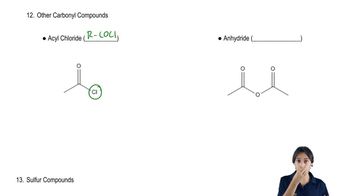
Recognizing acyl chlorides and anhydrides.

Nucleophilic Substitution

Nucleophilic substitution is a fundamental reaction mechanism in organic chemistry where a nucleophile attacks an electrophilic carbon atom, leading to the replacement of a leaving group. In the case of benzoyl chloride, nucleophiles like benzylamine and 4-chlorophenol can attack the carbonyl carbon, resulting in the formation of amides or esters, respectively. This concept is essential for understanding how different reagents interact with acyl chlorides.
추천 영상:
01:47
Nucleophiles and Electrophiles can react in Substitution Reactions.

Amide Formation

Amide formation occurs when an acyl chloride reacts with an amine, resulting in the creation of an amide bond (C=O-N). In the reaction with excess benzylamine, benzoyl chloride will yield N-benzoylbenzylamine, showcasing the transformation of the acyl chloride into a more stable amide. This process is significant in organic synthesis, as amides are important functional groups in various chemical compounds.
추천 영상:
01:33
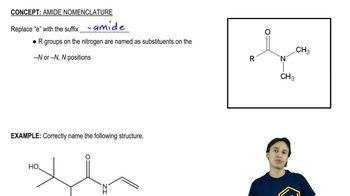
Amide Nomenclature