b. Explain why the rate of aminolysis of an ester cannot be increased by H+.
Ch. 15 - Reactions of Carboxylic Acids and Carboxylic Acid Derivatives
모든 교과서
Bruice 8th Edition
Ch. 15 - Reactions of Carboxylic Acids and Carboxylic Acid Derivatives
문제 25b
Bruice 8th Edition
Ch. 15 - Reactions of Carboxylic Acids and Carboxylic Acid Derivatives
문제 25b15장, 문제 25b
What products are obtained from the following reactions? b. phenyl acetate + excess ethanol + HCl
검증된 단계별 안내1
Step 1: Recognize the type of reaction. This is an acid-catalyzed esterification (Fischer esterification) or transesterification reaction, where phenyl acetate (an ester) reacts with excess ethanol in the presence of an acid catalyst (HCl).
Step 2: Understand the mechanism. In the presence of HCl, the carbonyl oxygen of the ester (phenyl acetate) gets protonated, making the carbonyl carbon more electrophilic and susceptible to nucleophilic attack by ethanol.
Step 3: Identify the nucleophile and electrophile. Ethanol acts as the nucleophile, attacking the electrophilic carbonyl carbon of phenyl acetate, leading to the formation of a tetrahedral intermediate.
Step 4: Follow the reaction pathway. The tetrahedral intermediate undergoes proton transfers and elimination of the leaving group (phenol, C6H5OH), resulting in the formation of a new ester, ethyl acetate (CH3COOCH2CH3).
Step 5: Summarize the products. The reaction produces ethyl acetate (the new ester) and phenol as the byproduct. The excess ethanol ensures the reaction proceeds to completion by shifting the equilibrium toward product formation.

비슷한 문제에 대한 검증된 영상 답변:
이 영상 해법은 위 문제에 도움이 된다고 튜터들이 추천한 것입니다.
영상 길이:
2m주요 개념
질문에 올바르게 답하기 위해 반드시 이해해야 하는 핵심 개념들은 다음과 같습니다.
Ester Hydrolysis
Ester hydrolysis is a reaction where an ester reacts with water or an alcohol in the presence of an acid or base, leading to the formation of an alcohol and a carboxylic acid. In this case, phenyl acetate undergoes hydrolysis in the presence of excess ethanol and HCl, resulting in the formation of phenol and acetic acid.
추천 영상:
가이드 코스
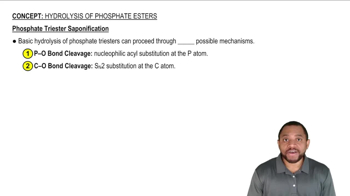
Hydrolysis of Phosphate Esters Concept 2
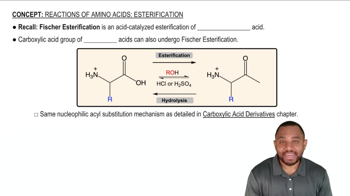
Fischer Esterification
Fischer esterification is a process where a carboxylic acid reacts with an alcohol to form an ester and water, typically catalyzed by an acid. In the context of the given reaction, the excess ethanol can also act as a reactant, potentially leading to the formation of ethyl acetate alongside the hydrolysis products.
추천 영상:
가이드 코스
Reactions of Amino Acids: Esterification Concept 1
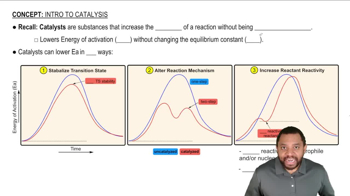
Role of Catalysts in Reactions
Catalysts, such as HCl in this reaction, are substances that increase the rate of a chemical reaction without being consumed in the process. In ester hydrolysis and Fischer esterification, HCl serves to protonate the carbonyl oxygen of the ester, making it more susceptible to nucleophilic attack by water or ethanol, thus facilitating the reaction.
추천 영상:
가이드 코스
Introduction to Catalysis Concept 1
관련 실천
교과서 질문
1248
views
교과서 질문
Using the mechanism for the acid-catalyzed hydrolysis of an ester as your guide, write the mechanism—showing all the curved arrows—for the acid-catalyzed reaction of acetic acid and methanol to form methyl acetate. Use HB+ and :B to represent the proton-donating and proton-removing species, respectively.
1656
views
교과서 질문
Write the mechanism for the acid-catalyzed transesterification of ethyl acetate with methanol.
1295
views
교과서 질문
Write the mechanism for the acid-catalyzed reaction of tert-butyl acetate with methanol.
1263
views
교과서 질문
What products are formed from the acid-catalyzed hydrolysis of the following esters?
a.
b.
1575
views
교과서 질문
Show the mechanism for the acid-catalyzed formation of 23c starting with the product obtained from its hydrolysis.
1018
views