Ch. 15 - Reactions of Carboxylic Acids and Carboxylic Acid Derivatives
Bruice - Organic Chemistry 8th Edition
Bruice8th EditionOrganic ChemistryISBN: 9780135213711당신이 사용하는 게 아니라요?교과서 변경
15장, 문제 59c,d

What products would you expect to obtain from the following reactions?
c. urea + water
d. β-ethylglutaric acid + acetyl chloride + Δ

검증된 단계별 안내
1
Step 1: Analyze the reaction between urea and water. Urea is a compound with the formula (NH2)2CO, containing two amine groups and a carbonyl group. Water (H2O) can act as a reactant in hydrolysis reactions.
Step 2: Recognize that hydrolysis of urea typically involves breaking the C-N bonds adjacent to the carbonyl group. This reaction is catalyzed by enzymes like urease in biological systems, but under chemical conditions, it can proceed with heat or acid/base catalysis.
Step 3: Predict the products of hydrolysis. The carbonyl group reacts with water, leading to the formation of carbon dioxide (CO2) and ammonia (NH3). This is a decomposition reaction.
Step 4: Write the balanced chemical equation for the reaction. The hydrolysis of urea can be represented as: (NH22)CO+H2O→CO2+NH3
Step 5: For part d, analyze the reaction between beta-ethylglutaric acid, acetyl chloride, and heat (Δ). This reaction likely involves acylation or condensation. Beta-ethylglutaric acid has two carboxylic acid groups and a beta-ethyl substituent. Acetyl chloride is a reactive acylating agent. Heat promotes the formation of an anhydride or ester. Predict the product based on the functional groups involved and write the mechanism for the reaction.

비슷한 문제에 대한 검증된 영상 답변:

이 영상 해법은 위 문제에 도움이 된다고 튜터들이 추천한 것입니다.
영상 길이:
1m

주요 개념

질문에 올바르게 답하기 위해 반드시 이해해야 하는 핵심 개념들은 다음과 같습니다.

Hydrolysis of Urea

Hydrolysis of urea involves the reaction of urea with water, typically catalyzed by an acid or base. This reaction leads to the formation of ammonia and carbon dioxide. Understanding this process is crucial for predicting the products of the reaction, as it illustrates how urea can break down in the presence of water.
추천 영상:
가이드 코스
1:00
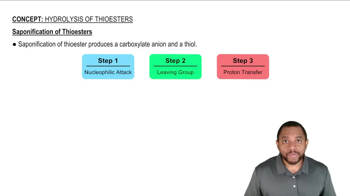
Hydrolysis of Thioesters Concept 2

Acid-Catalyzed Reactions

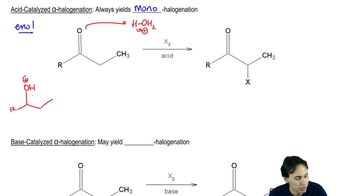
Acid-catalyzed reactions involve the use of an acid to increase the rate of a chemical reaction. In the context of ester hydrolysis, the acid donates protons, facilitating the breakdown of esters into their corresponding alcohols and acids. Recognizing the role of acid in these reactions is essential for understanding the mechanisms and products formed.
추천 영상:
03:09
Acid Catalyzed

Acyl Chlorides and Their Reactivity

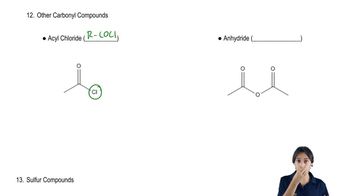
Acyl chlorides are highly reactive compounds that can undergo various reactions, including acylation and hydrolysis. When reacted with carboxylic acids or alcohols, they typically yield esters. Understanding the reactivity of acyl chlorides is important for predicting the products of the reaction involving beta-ethylglutaric acid and acetyl chloride.
추천 영상:
01:57
Recognizing acyl chlorides and anhydrides.