Ch. 15 - Reactions of Carboxylic Acids and Carboxylic Acid Derivatives
Bruice - Organic Chemistry 8th Edition
Bruice8th EditionOrganic ChemistryISBN: 9780135213711당신이 사용하는 게 아니라요?교과서 변경
15장, 문제 58a,b

What reagents would you use to convert methyl propanoate to the following compounds?
a. isopropyl propanoate
b. sodium propanoate

검증된 단계별 안내
1
Step 1: To convert methyl propanoate to isopropyl propanoate, perform a transesterification reaction. Use isopropanol (isopropyl alcohol) as the alcohol reagent and an acid catalyst such as sulfuric acid (H₂SO₄) to facilitate the exchange of the methyl group with the isopropyl group.
Step 2: Heat the reaction mixture to promote the transesterification process, ensuring the methyl group is replaced by the isopropyl group to form isopropyl propanoate.
Step 3: To convert methyl propanoate to sodium propanoate, perform a saponification reaction. Use a strong base such as sodium hydroxide (NaOH) to hydrolyze the ester bond in methyl propanoate.
Step 4: During saponification, the ester bond is broken, yielding propanoic acid and methanol. The propanoic acid reacts with the sodium hydroxide to form sodium propanoate.
Step 5: Isolate the sodium propanoate by neutralizing the reaction mixture and removing any excess water or byproducts.

비슷한 문제에 대한 검증된 영상 답변:

이 영상 해법은 위 문제에 도움이 된다고 튜터들이 추천한 것입니다.
영상 길이:
5m

주요 개념

질문에 올바르게 답하기 위해 반드시 이해해야 하는 핵심 개념들은 다음과 같습니다.

Transesterification

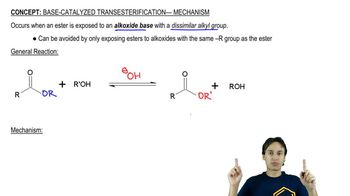
Transesterification is a chemical reaction where an ester reacts with an alcohol to form a different ester and a new alcohol. This process involves the exchange of the alkoxy group of the ester with the alcohol, which is crucial for converting methyl propanoate to isopropyl propanoate. The reaction typically requires an acid or base catalyst to proceed efficiently.
추천 영상:
02:49
General Reaction

Saponification

Saponification is the process of converting an ester into a carboxylic acid and an alcohol through hydrolysis, usually in the presence of a strong base like sodium hydroxide. In the context of the question, it is relevant for converting methyl propanoate to sodium propanoate, where the ester is hydrolyzed to yield the sodium salt of the corresponding acid.
추천 영상:
03:27
Mechanism

Reagents for Ester Reactions

The choice of reagents is critical in ester reactions. For transesterification, an alcohol (like isopropanol) is needed, while for saponification, a strong base (such as sodium hydroxide or sodium carbonate) is required. Understanding the role of these reagents helps in determining the correct pathway for the desired product transformations.
추천 영상:
02:39
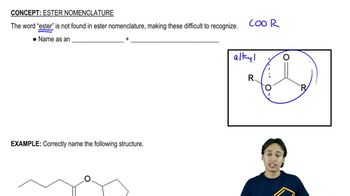
Ester Nomenclature