Ch. 15 - Reactions of Carboxylic Acids and Carboxylic Acid Derivatives
Bruice - Organic Chemistry 8th Edition
Bruice8th EditionOrganic ChemistryISBN: 9780135213711당신이 사용하는 게 아니라요?교과서 변경
15장, 문제 34a

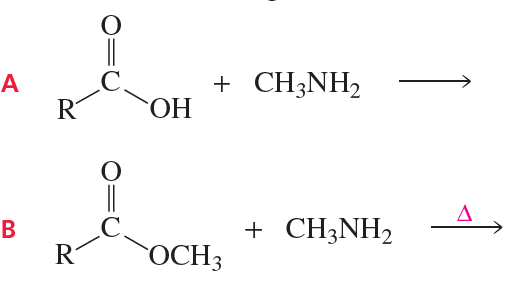
Which of the following reactions lead to the formation of an amide?
Two chemical reaction diagrams showing the formation of an amide from different reactants.

검증된 단계별 안내
1
Step 1: Understand the functional groups involved in the reactions. In both reactions, the starting materials include a carboxylic acid derivative (reaction A: carboxylic acid, reaction B: ester) and a nucleophile (methylamine, CH3NH2). Amides are formed when a carboxylic acid derivative reacts with an amine or ammonia.
Step 2: Analyze reaction A. The carboxylic acid (RC=O(OH)) reacts with methylamine (CH3NH2). This reaction typically leads to the formation of an amide, but it requires a dehydrating agent or heat to remove water (H2O) formed during the reaction. Without these conditions, the reaction may not proceed efficiently.
Step 3: Analyze reaction B. The ester (RC=O(OCH3)) reacts with methylamine (CH3NH2) under heat (Δ). This is an example of aminolysis of an ester, where the amine acts as a nucleophile and replaces the alkoxy group (-OCH3) to form an amide. The heat provided facilitates this substitution reaction.
Step 4: Compare the two reactions. Reaction A may lead to the formation of an amide if appropriate conditions (e.g., heat or a dehydrating agent) are applied. Reaction B, under the given conditions (Δ), is more likely to proceed efficiently to form an amide due to the reactivity of esters with amines under heat.
Step 5: Conclude that reaction B is more favorable for the formation of an amide under the given conditions. Reaction A may also form an amide but requires additional conditions to drive the reaction forward.

비슷한 문제에 대한 검증된 영상 답변:

이 영상 해법은 위 문제에 도움이 된다고 튜터들이 추천한 것입니다.

주요 개념

질문에 올바르게 답하기 위해 반드시 이해해야 하는 핵심 개념들은 다음과 같습니다.

Amide Formation

Amides are formed when a carboxylic acid reacts with an amine, resulting in the replacement of the hydroxyl group (-OH) of the acid with an amine group (-NH2). This reaction typically involves the condensation of the two reactants, leading to the release of water. Understanding this process is crucial for identifying which reactions yield amides.
추천 영상:
01:33
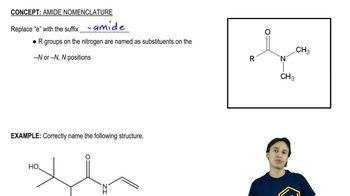
Amide Nomenclature

Nucleophilic Acyl Substitution

Nucleophilic acyl substitution is a fundamental reaction mechanism in organic chemistry where a nucleophile attacks the electrophilic carbon of a carbonyl group (C=O). In the context of amide formation, the amine acts as the nucleophile, attacking the carbonyl carbon of the carboxylic acid or its derivatives. This mechanism is essential for understanding how amides can be synthesized from various carbonyl-containing compounds.
추천 영상:
01:47
Nucleophiles and Electrophiles can react in Substitution Reactions.

Reactivity of Carbonyl Compounds

Different carbonyl compounds exhibit varying reactivities based on their substituents. For instance, carboxylic acids and their derivatives (like acid chlorides and esters) are more reactive than simple aldehydes or ketones. Recognizing the reactivity of these compounds is vital for predicting which reactions will successfully lead to amide formation, as the presence of specific functional groups can significantly influence the outcome.
추천 영상:
01:40
Defining meso compounds.