Ch. 16 - Reactions of Aldehydes and Ketones • More Reactions of Carboxylic Acid Derivatives
Bruice - Organic Chemistry 8th Edition
Bruice8th EditionOrganic ChemistryISBN: 9780135213711당신이 사용하는 게 아니라요?교과서 변경
16장, 문제 57a(1)

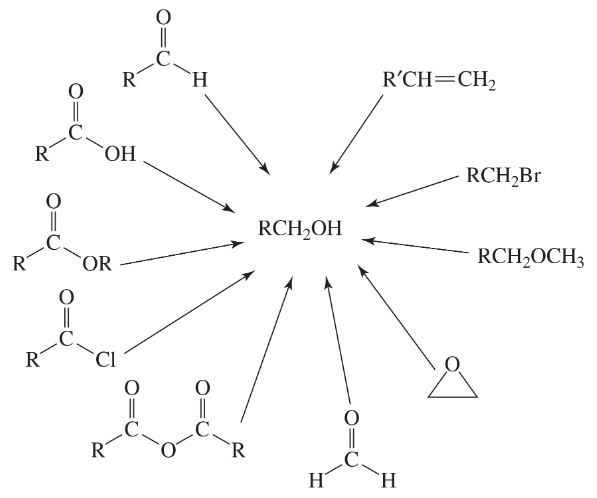
Show the reagents required to form the primary alcohol in each of the following reactions.


검증된 단계별 안내
1
Step 1: Identify the starting material and the product. The starting material is an aldehyde (butanal), and the product is a primary alcohol (butanol).
Step 2: Recognize the type of reaction. This is a reduction reaction where the aldehyde functional group is reduced to a primary alcohol.
Step 3: Select the appropriate reducing agent. Common reducing agents for this transformation include sodium borohydride (NaBH₄) or lithium aluminum hydride (LiAlH₄).
Step 4: Choose the solvent. For NaBH₄, a protic solvent like ethanol or water is typically used. For LiAlH₄, an aprotic solvent like diethyl ether is required due to its reactivity.
Step 5: Write the reaction conditions. For example, if using NaBH₄, the reaction would proceed under mild conditions with ethanol as the solvent, converting butanal to butanol.

비슷한 문제에 대한 검증된 영상 답변:

이 영상 해법은 위 문제에 도움이 된다고 튜터들이 추천한 것입니다.
영상 길이:
4m

주요 개념

질문에 올바르게 답하기 위해 반드시 이해해야 하는 핵심 개념들은 다음과 같습니다.

Reduction of Carbonyl Compounds

The conversion of carbonyl compounds (aldehydes or ketones) to alcohols involves a reduction reaction. This process typically requires a reducing agent, which donates electrons to the carbonyl carbon, resulting in the formation of an alcohol. In the case of aldehydes, the product is a primary alcohol, while ketones yield secondary alcohols.
추천 영상:
01:40
Defining meso compounds.

Common Reducing Agents

Common reducing agents used in organic chemistry for the reduction of carbonyl compounds include lithium aluminum hydride (LiAlH4) and sodium borohydride (NaBH4). LiAlH4 is a strong reducing agent capable of reducing both aldehydes and ketones, while NaBH4 is milder and typically used for aldehydes and some ketones, making it a safer option in many laboratory settings.
추천 영상:
09:28
Reducing Agents

Mechanism of Reduction

The mechanism of reduction of carbonyl compounds involves nucleophilic attack by the hydride ion (H-) from the reducing agent on the electrophilic carbon of the carbonyl group. This leads to the formation of an alkoxide intermediate, which can then be protonated by water or an acid to yield the corresponding alcohol. Understanding this mechanism is crucial for predicting the outcome of the reaction.
추천 영상:
04:40
Birch Reduction Mechanism