Ch. 16 - Reactions of Aldehydes and Ketones • More Reactions of Carboxylic Acid Derivatives
Bruice - Organic Chemistry 8th Edition
Bruice8th EditionOrganic ChemistryISBN: 9780135213711당신이 사용하는 게 아니라요?교과서 변경
16장, 문제 72c

How could you convert N-methylbenzamide to the following compounds?
c. methyl benzoate

검증된 단계별 안내
1
Step 1: Recognize that N-methylbenzamide is an amide, and methyl benzoate is an ester. The conversion involves replacing the amide group (-CONHCH3) with an ester group (-COOCH3). This typically requires hydrolysis followed by esterification.
Step 2: Perform acidic or basic hydrolysis of N-methylbenzamide to break the amide bond. This will yield benzoic acid (C6H5COOH) and methylamine (CH3NH2). Use a strong acid like HCl or a strong base like NaOH for this step.
Step 3: Isolate the benzoic acid from the reaction mixture. If basic hydrolysis was used, acidify the solution to precipitate benzoic acid.
Step 4: React the benzoic acid with methanol (CH3OH) in the presence of an acid catalyst, such as sulfuric acid (H2SO4), to perform esterification. This will convert benzoic acid into methyl benzoate.
Step 5: Purify the methyl benzoate product using techniques such as distillation or recrystallization, depending on the reaction conditions and impurities.

비슷한 문제에 대한 검증된 영상 답변:

이 영상 해법은 위 문제에 도움이 된다고 튜터들이 추천한 것입니다.
영상 길이:
5m

주요 개념

질문에 올바르게 답하기 위해 반드시 이해해야 하는 핵심 개념들은 다음과 같습니다.

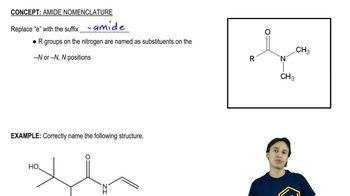
Amide Hydrolysis

Amide hydrolysis is a reaction where an amide is converted into a carboxylic acid and an amine or ammonia, typically in the presence of water and an acid or base. This reaction is crucial for understanding how to transform N-methylbenzamide into its corresponding carboxylic acid, which can then be further converted into methyl benzoate.
추천 영상:
01:33
Amide Nomenclature

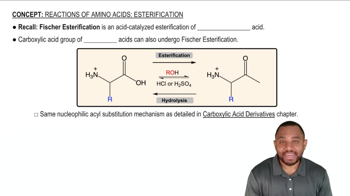
Esterification

Esterification is the process of forming an ester from a carboxylic acid and an alcohol, usually in the presence of an acid catalyst. In this case, the carboxylic acid derived from the hydrolysis of N-methylbenzamide can react with methanol to produce methyl benzoate, illustrating the importance of this reaction in organic synthesis.
추천 영상:
가이드 코스
1:21
Reactions of Amino Acids: Esterification Concept 1

Nucleophilic Acyl Substitution

Nucleophilic acyl substitution is a fundamental reaction mechanism in organic chemistry where a nucleophile attacks the carbonyl carbon of an acyl compound, leading to the substitution of a leaving group. This mechanism is key in the conversion of the carboxylic acid formed from N-methylbenzamide into the ester methyl benzoate, as the alcohol acts as the nucleophile.
추천 영상:
01:47
Nucleophiles and Electrophiles can react in Substitution Reactions.