Ch. 16 - Reactions of Aldehydes and Ketones • More Reactions of Carboxylic Acid Derivatives
Bruice - Organic Chemistry 8th Edition
Bruice8th EditionOrganic ChemistryISBN: 9780135213711당신이 사용하는 게 아니라요?교과서 변경
16장, 문제 74b

List three different sets of reagents (each set consisting of a carbonyl compound and a Grignard reagent) that could be used to prepare each of the following tertiary alcohols:
b.

검증된 단계별 안내
1
Step 1: Analyze the structure of the tertiary alcohol provided. The central carbon is bonded to three alkyl groups (CH2CH3, CH2CH2CH3, and CH2CH3) and a hydroxyl group (-OH). This indicates that the alcohol is tertiary, meaning it was formed by the addition of a Grignard reagent to a carbonyl compound.
Step 2: To synthesize this tertiary alcohol, identify the carbonyl compound that would react with a Grignard reagent to form the desired structure. The carbonyl compound must have one of the alkyl groups already attached to the carbonyl carbon.
Step 3: Select the Grignard reagent that will add the remaining alkyl group to the carbonyl compound. Grignard reagents are organomagnesium compounds (R-MgX), where R is the alkyl group to be added.
Step 4: Repeat the process to identify three different sets of reagents. For example: (1) Use a ketone with one alkyl group and a Grignard reagent with another alkyl group, (2) Use a different ketone and Grignard reagent combination, and (3) Use an aldehyde and a Grignard reagent to achieve the same tertiary alcohol.
Step 5: Ensure that each set of reagents (carbonyl compound and Grignard reagent) leads to the formation of the same tertiary alcohol. Verify the connectivity of the alkyl groups and the hydroxyl group in the final product for each set.

비슷한 문제에 대한 검증된 영상 답변:

이 영상 해법은 위 문제에 도움이 된다고 튜터들이 추천한 것입니다.
영상 길이:
4m

주요 개념

질문에 올바르게 답하기 위해 반드시 이해해야 하는 핵심 개념들은 다음과 같습니다.

Carbonyl Compounds

Carbonyl compounds are organic molecules that contain a carbon atom double-bonded to an oxygen atom (C=O). They are classified into two main types: aldehydes and ketones. Understanding the reactivity of carbonyl compounds is crucial, as they serve as electrophiles in nucleophilic addition reactions, which are fundamental in organic synthesis.
추천 영상:
01:40
Defining meso compounds.

Grignard Reagents

Grignard reagents are organomagnesium compounds represented as RMgX, where R is an organic group and X is a halogen. They are powerful nucleophiles that react with electrophiles, such as carbonyl compounds, to form new carbon-carbon bonds. Their ability to add to carbonyls is essential for synthesizing alcohols, particularly tertiary alcohols when reacting with ketones.
추천 영상:
02:12
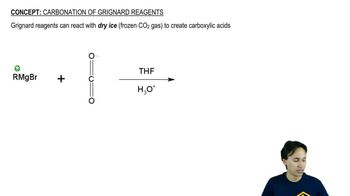
Carbonation of Grignard Reagents

Tertiary Alcohols

Tertiary alcohols are alcohols where the hydroxyl (-OH) group is attached to a carbon atom that is bonded to three other carbon atoms. They are typically formed through the reaction of Grignard reagents with ketones. Understanding the structure and formation of tertiary alcohols is important for predicting the outcomes of organic reactions and for designing synthetic pathways.
추천 영상:
가이드 코스
2:07
Tertiary Protein Structure Concept 1