Ch. 16 - Reactions of Aldehydes and Ketones • More Reactions of Carboxylic Acid Derivatives
Bruice - Organic Chemistry 8th Edition
Bruice8th EditionOrganic ChemistryISBN: 9780135213711당신이 사용하는 게 아니라요?교과서 변경
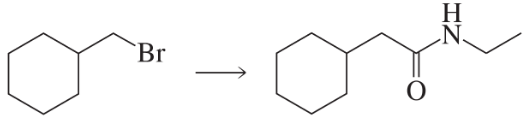
16장, 문제 62f

Show how each of the following compounds can be prepared, using the given starting material:
f. Chemical reaction showing the conversion of a brominated compound to an amide with a carbonyl group.

검증된 단계별 안내
1
Identify the target compound and analyze its functional groups and structure. Determine the transformations required to convert the given starting material into the target compound.
Examine the starting material and identify its functional groups and structure. Consider the reactivity of the starting material and how it can be manipulated to introduce or modify functional groups.
Plan a synthetic route by selecting appropriate reagents and reaction conditions for each step. Consider reactions such as substitution, elimination, addition, oxidation, reduction, or rearrangement, depending on the functional groups involved.
Write out the reaction mechanism for each step in the synthetic route. Show how the starting material reacts with the chosen reagents to form intermediates and ultimately the target compound.
Verify the feasibility of the synthetic route by checking for compatibility of reagents, reaction conditions, and intermediates. Ensure that the proposed steps lead to the desired product without unwanted side reactions.

비슷한 문제에 대한 검증된 영상 답변:

이 영상 해법은 위 문제에 도움이 된다고 튜터들이 추천한 것입니다.
영상 길이:
4m

주요 개념

질문에 올바르게 답하기 위해 반드시 이해해야 하는 핵심 개념들은 다음과 같습니다.

Functional Groups

Functional groups are specific groups of atoms within molecules that are responsible for the characteristic chemical reactions of those molecules. Understanding functional groups is essential in organic chemistry as they dictate the reactivity and properties of compounds. For example, alcohols contain hydroxyl (-OH) groups, which influence their solubility and reactivity.
추천 영상:
02:36
Identifying Functional Groups

Reaction Mechanisms

A reaction mechanism is a step-by-step description of how a chemical reaction occurs at the molecular level. It outlines the sequence of events, including bond breaking and forming, that lead to the transformation of reactants into products. Familiarity with common mechanisms, such as nucleophilic substitution or elimination, is crucial for predicting the outcomes of reactions.
추천 영상:
02:16
Heck Reaction Mechanism

Synthesis Strategies

Synthesis strategies involve planning the steps required to construct a target molecule from available starting materials. This includes selecting appropriate reactions, reagents, and conditions to achieve the desired transformation efficiently. A solid grasp of retrosynthetic analysis helps chemists break down complex molecules into simpler precursors, guiding the synthesis process.
추천 영상:
가이드 코스
1:16
Synthesis of Amino Acids: Strecker Synthesis Example 1