Ch. 16 - Reactions of Aldehydes and Ketones • More Reactions of Carboxylic Acid Derivatives
Bruice - Organic Chemistry 8th Edition
Bruice8th EditionOrganic ChemistryISBN: 9780135213711당신이 사용하는 게 아니라요?교과서 변경
16장, 문제 35a

The compounds commonly known as 'amino acids' are actually α-aminocarboxylic-aminocarboxylic acids. What carbonyl compounds should be used to synthesize the two amino acids shown here?
a.

검증된 단계별 안내
1
Step 1: Identify the amino acid structure shown in the image. The compound has an amino group (-NH2), a carboxylate group (-COO⁻), and a side chain containing an isopropyl group. This structure corresponds to leucine, an α-amino acid.
Step 2: Recall the Strecker synthesis method for amino acids. This method involves the reaction of an aldehyde with ammonia (NH3) and hydrogen cyanide (HCN) to form an α-aminonitrile, which is then hydrolyzed to yield the amino acid.
Step 3: Determine the aldehyde required for the synthesis of leucine. The side chain of leucine (isopropyl group) suggests that the aldehyde should be isobutyraldehyde (CH3CH(CH3)CHO). This aldehyde provides the correct carbon skeleton for leucine.
Step 4: Write the reaction sequence. In the Strecker synthesis, isobutyraldehyde reacts with ammonia and hydrogen cyanide to form an α-aminonitrile intermediate. This intermediate is then hydrolyzed under acidic conditions to produce leucine.
Step 5: Summarize the process. To synthesize leucine, the carbonyl compound is isobutyraldehyde. This compound undergoes the Strecker synthesis pathway to yield the desired amino acid.

비슷한 문제에 대한 검증된 영상 답변:

이 영상 해법은 위 문제에 도움이 된다고 튜터들이 추천한 것입니다.
영상 길이:
1m

주요 개념

질문에 올바르게 답하기 위해 반드시 이해해야 하는 핵심 개념들은 다음과 같습니다.

Amino Acids

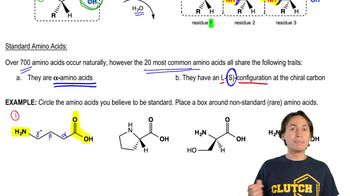
Amino acids are organic compounds that serve as the building blocks of proteins. They contain both an amino group (-NH2) and a carboxylic acid group (-COOH), making them α-aminocarboxylic acids. The structure of amino acids allows them to participate in various biochemical reactions, including the formation of peptide bonds, which link them together to form proteins.
추천 영상:
09:36
Standard Amino Acids

Reductive Amination

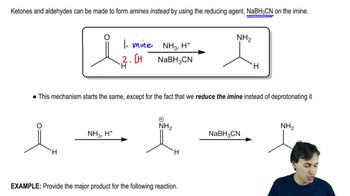
Reductive amination is a chemical reaction that involves the conversion of a carbonyl compound (such as an aldehyde or ketone) into an amine. This process typically involves the formation of an imine intermediate, which is then reduced to yield the amine. In the context of amino acid synthesis, this reaction is crucial for introducing the amino group into the carbon skeleton derived from the carbonyl compound.
추천 영상:
07:12
Reductive Amination

Carbonyl Compounds

Carbonyl compounds are organic molecules that contain a carbonyl group (C=O), which can be found in aldehydes, ketones, carboxylic acids, and esters. In the synthesis of amino acids, specific carbonyl compounds are selected based on their ability to react with amines through reductive amination, ultimately leading to the formation of the desired amino acid structure.
추천 영상:
01:40
Defining meso compounds.