Ch. 16 - Reactions of Aldehydes and Ketones • More Reactions of Carboxylic Acid Derivatives
Bruice - Organic Chemistry 8th Edition
Bruice8th EditionOrganic ChemistryISBN: 9780135213711당신이 사용하는 게 아니라요?교과서 변경
16장, 문제 30a

The pKa of protonated acetone is about –7.5 and the pKa of protonated hydroxylamine is 6.0.
a. In a reaction with hydroxylamine at pH 4.5 (Figure 16.2), what fraction of acetone is present in its acidic, protonated form?
<IMAGE>

검증된 단계별 안내
1
Step 1: Understand the relationship between pKa and pH. The fraction of a compound in its protonated form can be calculated using the Henderson-Hasselbalch equation: \( \text{pH} = \text{pKa} + \log \left( \frac{[\text{A}^-]}{[\text{HA}]} \right) \). Rearrange this equation to solve for the fraction of the protonated form \( [\text{HA}] \).
Step 2: Identify the relevant pKa value for protonated acetone, which is given as \( -7.5 \). The pH of the reaction is specified as \( 4.5 \). Substitute these values into the Henderson-Hasselbalch equation.
Step 3: Calculate the ratio \( \frac{[\text{A}^-]}{[\text{HA}]} \) using the equation \( \log \left( \frac{[\text{A}^-]}{[\text{HA}]} \right) = \text{pH} - \text{pKa} \). This will give the logarithmic ratio of the deprotonated to protonated forms.
Step 4: Convert the logarithmic ratio to a linear ratio by taking the antilog (10 raised to the power of the calculated value). This will yield \( \frac{[\text{A}^-]}{[\text{HA}]} \).
Step 5: Use the ratio \( \frac{[\text{A}^-]}{[\text{HA}]} \) to calculate the fraction of acetone in its protonated form \( [\text{HA}] \) using the formula \( \text{Fraction of HA} = \frac{1}{1 + \frac{[\text{A}^-]}{[\text{HA}]} } \).

비슷한 문제에 대한 검증된 영상 답변:

이 영상 해법은 위 문제에 도움이 된다고 튜터들이 추천한 것입니다.
영상 길이:
5m

주요 개념

질문에 올바르게 답하기 위해 반드시 이해해야 하는 핵심 개념들은 다음과 같습니다.

Acid-Base Equilibrium

Acid-base equilibrium refers to the balance between proton donors (acids) and proton acceptors (bases) in a solution. The pH of a solution indicates its acidity or basicity, influencing the protonation state of compounds. Understanding this concept is crucial for predicting the fraction of a compound in its protonated form at a given pH.
추천 영상:
04:00
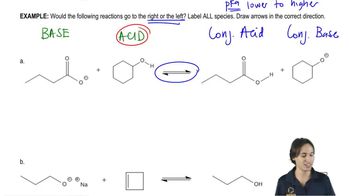
Determining Acid/Base Equilibrium

pKa and pH Relationship

The pKa of a compound is the pH at which half of the species are protonated and half are deprotonated. It is a critical value for determining the protonation state of a compound in solution. By comparing the pH of the solution to the pKa of the compound, one can calculate the fraction of the compound that exists in its protonated form using the Henderson-Hasselbalch equation.
추천 영상:
02:15
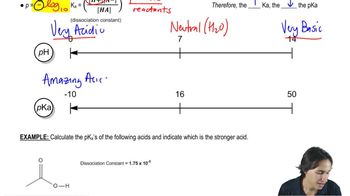
The pH scale vs. the pKa scale.

Henderson-Hasselbalch Equation

The Henderson-Hasselbalch equation is a mathematical formula used to relate the pH of a solution to the pKa of an acid and the ratio of the concentrations of its protonated and deprotonated forms. It is expressed as pH = pKa + log([A-]/[HA]). This equation is essential for calculating the fraction of acetone that is protonated at a specific pH, allowing for a quantitative analysis of the reaction conditions.
추천 영상:
05:02
Breaking down the different terms of the Gibbs Free Energy equation.