Ch. 16 - Reactions of Aldehydes and Ketones • More Reactions of Carboxylic Acid Derivatives
Bruice - Organic Chemistry 8th Edition
Bruice8th EditionOrganic ChemistryISBN: 9780135213711당신이 사용하는 게 아니라요?교과서 변경
16장, 문제 20c,d

What alcohols are obtained from the reduction of the following compounds with sodium borohydride?
c. 4-tert-butylcyclohexanone
d. acetophenone

검증된 단계별 안내
1
Identify the functional group in each compound. For 4-tert-butylcyclohexanone, the functional group is a ketone (C=O) attached to a cyclohexane ring with a tert-butyl group at the 4-position. For acetophenone, the functional group is also a ketone (C=O) attached to a benzene ring with a methyl group on the carbonyl carbon.
Understand the role of sodium borohydride (NaBH₄). Sodium borohydride is a reducing agent that selectively reduces ketones and aldehydes to their corresponding alcohols. It donates a hydride ion (H⁻) to the carbonyl carbon, converting the C=O bond into a C-OH bond.
For 4-tert-butylcyclohexanone, the reduction will occur at the ketone group. The hydride ion from NaBH₄ will attack the carbonyl carbon, breaking the double bond and forming a secondary alcohol. The tert-butyl group remains unchanged.
For acetophenone, the reduction will also occur at the ketone group. The hydride ion will attack the carbonyl carbon, converting the ketone into a secondary alcohol. The benzene ring and the methyl group remain unchanged.
After the reduction, the products are alcohols. For 4-tert-butylcyclohexanone, the product is 4-tert-butylcyclohexanol. For acetophenone, the product is 1-phenylethanol. These alcohols are formed as a result of the reduction of the ketone groups in the original compounds.

비슷한 문제에 대한 검증된 영상 답변:

이 영상 해법은 위 문제에 도움이 된다고 튜터들이 추천한 것입니다.
영상 길이:
1m

주요 개념

질문에 올바르게 답하기 위해 반드시 이해해야 하는 핵심 개념들은 다음과 같습니다.

Reduction Reactions

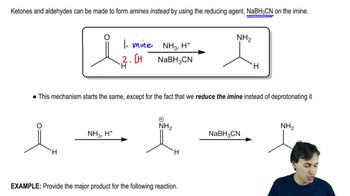
Reduction reactions involve the gain of electrons or hydrogen, or the loss of oxygen in a chemical species. In organic chemistry, this often refers to the conversion of carbonyl compounds (like ketones and aldehydes) into alcohols. Sodium borohydride (NaBH4) is a common reducing agent used for this purpose, as it selectively reduces ketones and aldehydes to their corresponding alcohols.
추천 영상:
07:12
Reductive Amination

Sodium Borohydride

Sodium borohydride is a powerful and selective reducing agent commonly used in organic synthesis. It is particularly effective for reducing ketones and aldehydes to alcohols without affecting other functional groups. Its mild nature allows for the reduction of sensitive compounds, making it a preferred choice in laboratory settings for producing alcohols from carbonyl precursors.
추천 영상:
03:19
Sodium Alkynide Alkylation

Structure of Alcohols

Alcohols are organic compounds characterized by the presence of one or more hydroxyl (-OH) groups attached to a carbon atom. The structure of the starting carbonyl compound influences the structure of the resulting alcohol. For example, the reduction of 4-tert-butylcyclohexanone will yield a tertiary alcohol, while the reduction of acetophenone will yield a secondary alcohol, reflecting the different carbon environments in these compounds.
추천 영상:
01:01
How to name alcohols