Ch. 16 - Reactions of Aldehydes and Ketones • More Reactions of Carboxylic Acid Derivatives
Bruice - Organic Chemistry 8th Edition
Bruice8th EditionOrganic ChemistryISBN: 9780135213711당신이 사용하는 게 아니라요?교과서 변경
16장, 문제 39(3)

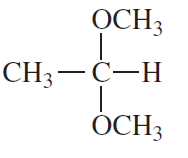
Which of the following are a. hemiacetals? b. acetals? c. hydrates?
3.

검증된 단계별 안내
1
Step 1: Analyze the given structure. The molecule contains a central carbon atom bonded to two oxygen atoms. One oxygen atom is part of a methoxy group (-OCH3), and the other oxygen atom is also part of a methoxy group (-OCH3). The central carbon is also bonded to a methyl group (-CH3).
Step 2: Recall the definitions of hemiacetals, acetals, and hydrates. A hemiacetal contains one -OH group and one -OR group attached to the same carbon. An acetal contains two -OR groups attached to the same carbon. A hydrate contains two -OH groups attached to the same carbon.
Step 3: Compare the structure to the definitions. In this molecule, the central carbon is bonded to two -OR groups (-OCH3), which matches the definition of an acetal.
Step 4: Confirm that the molecule does not fit the definitions of a hemiacetal or a hydrate. There is no -OH group present, so it cannot be a hemiacetal or a hydrate.
Step 5: Conclude that the given structure is an acetal based on the presence of two -OR groups attached to the same carbon atom.

비슷한 문제에 대한 검증된 영상 답변:

이 영상 해법은 위 문제에 도움이 된다고 튜터들이 추천한 것입니다.
영상 길이:
3m

주요 개념

질문에 올바르게 답하기 위해 반드시 이해해야 하는 핵심 개념들은 다음과 같습니다.

Hemiacetals

Hemiacetals are formed when an aldehyde or ketone reacts with an alcohol, resulting in a compound that contains both an alcohol (-OH) and an ether (-O-) functional group. They typically have one alkoxy group and one hydroxyl group attached to the same carbon atom. Hemiacetals are often intermediates in the formation of acetals and can be identified by the presence of a single -OH group on the carbon that was originally part of the carbonyl.
추천 영상:
06:23
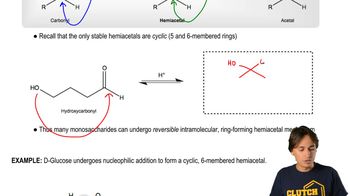
Monosaccharides - Forming Cyclic Hemiacetals

Acetals

Acetals are derived from hemiacetals when a second equivalent of alcohol reacts with the hemiacetal, replacing the hydroxyl group with another alkoxy group. This results in a carbon atom bonded to two -O- groups and no -OH group. Acetals are stable under neutral conditions and are commonly formed from aldehydes or ketones in the presence of alcohol, making them important in organic synthesis and carbohydrate chemistry.
추천 영상:
04:29
Acetal Protecting Group

Hydrates

Hydrates are formed when water adds to a carbonyl compound, such as an aldehyde or ketone, resulting in a molecule that contains both a hydroxyl group and a carbonyl group. The product is typically a geminal diol, where two functional groups are attached to the same carbon atom. Hydrates are often less stable than their carbonyl precursors and can exist in equilibrium with them, especially in aqueous solutions.
추천 영상:
09:11
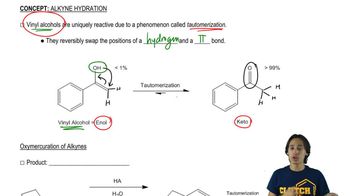
Alkyne Hydration