

Ch. 17 - Reactions at the Alpha-Carbon
Bruice - Organic Chemistry 8th Edition
Bruice8th EditionOrganic ChemistryISBN: 9780135213711당신이 사용하는 게 아니라요?교과서 변경
17장, 문제 90

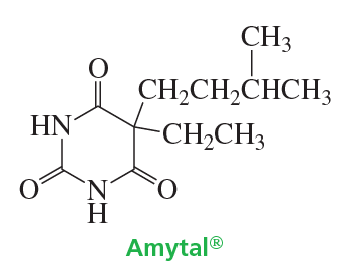
Amobarbital is a sedative marketed under the trade name Amytal. Propose a synthesis of amobarbital, using diethyl malonate and urea as two of the starting materials.
Chemical structure of amobarbital, a sedative, labeled with the trade name Amytal.

검증된 단계별 안내
1
Step 1: Begin with diethyl malonate as the starting material. Perform a base-catalyzed alkylation reaction using ethyl bromide to introduce the ethyl group at the alpha-carbon of diethyl malonate. This step involves deprotonation of the alpha-carbon followed by nucleophilic substitution.
Step 2: Hydrolyze the diethyl malonate derivative under acidic or basic conditions to convert the ester groups into carboxylic acids. This step yields a malonic acid derivative with the ethyl group attached.
Step 3: Decarboxylate the malonic acid derivative by heating it. This removes one of the carboxylic acid groups, leaving behind a mono-carboxylic acid with the ethyl group attached.
Step 4: React the resulting mono-carboxylic acid with urea under acidic or basic conditions to form the barbituric acid core. This step involves a condensation reaction where urea contributes the nitrogen atoms to the cyclic structure.
Step 5: Perform a second alkylation reaction on the barbituric acid core using allyl bromide to introduce the allyl group at the nitrogen atom. This final step completes the synthesis of amobarbital.

비슷한 문제에 대한 검증된 영상 답변:

이 영상 해법은 위 문제에 도움이 된다고 튜터들이 추천한 것입니다.
영상 길이:
2m

주요 개념

질문에 올바르게 답하기 위해 반드시 이해해야 하는 핵심 개념들은 다음과 같습니다.

Diethyl Malonate

Diethyl malonate is a versatile compound used in organic synthesis, particularly in the malonic ester synthesis. It contains two ester functional groups and is often employed as a nucleophile in alkylation reactions. Its ability to form enolates makes it a key intermediate in the synthesis of various compounds, including barbiturates like amobarbital.
추천 영상:
01:25
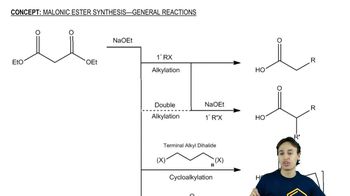
General Reactions

Urea

Urea is a simple organic compound with the formula CO(NH2)2, and it serves as a key building block in the synthesis of many nitrogen-containing compounds. In the context of barbiturate synthesis, urea reacts with malonic esters to form barbituric acid, which can be further modified to produce sedatives like amobarbital. Its reactivity is crucial for forming the necessary carbon-nitrogen bonds.
추천 영상:
가이드 코스
3:10
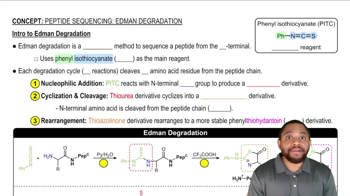
Peptide Sequencing: Edman Degradation Concept 1

Barbiturate Synthesis

Barbiturate synthesis involves the formation of a barbituric acid derivative through the condensation of urea and diethyl malonate. This process typically includes cyclization and subsequent modifications to yield various barbiturates, which are central nervous system depressants. Understanding the reaction mechanisms and functional group transformations is essential for proposing effective synthetic routes for compounds like amobarbital.
추천 영상:
가이드 코스
1:16
Synthesis of Amino Acids: Strecker Synthesis Example 1