Ch. 17 - Reactions at the Alpha-Carbon
Bruice - Organic Chemistry 8th Edition
Bruice8th EditionOrganic ChemistryISBN: 9780135213711당신이 사용하는 게 아니라요?교과서 변경
17장, 문제 7d,e

Draw the enol tautomers for each of the following compounds. For compounds that have more than one enol tautomer, indicate the one that is more stable.
d.
e.

검증된 단계별 안내
1
Step 1: Understand the concept of keto-enol tautomerism. Keto-enol tautomerism is a chemical equilibrium between a ketone (or aldehyde) and its corresponding enol form. The enol form involves a hydroxyl group (-OH) attached to a carbon-carbon double bond.
Step 2: Analyze the first compound (cyclohexane-1,3-dione). Identify the alpha-hydrogens (hydrogens attached to the carbon adjacent to the carbonyl group). These hydrogens are necessary for enol formation. In this case, both carbonyl groups have alpha-hydrogens available.
Step 3: Draw the enol tautomers for the first compound. For each carbonyl group, the alpha-hydrogen can be removed, and the resulting negative charge can form a double bond with the adjacent carbon. The oxygen of the carbonyl group will then gain a proton to form the hydroxyl group. Consider resonance stabilization to determine the most stable enol tautomer.
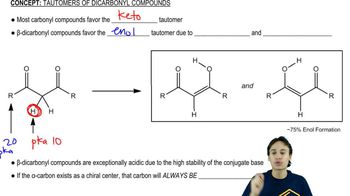
Step 4: Analyze the second compound (2,4-pentanedione). This compound has two carbonyl groups separated by a single carbon atom. Identify the alpha-hydrogens on the central carbon atom. These hydrogens can be removed to form enol tautomers. The enol tautomer with intramolecular hydrogen bonding is typically more stable due to resonance stabilization.
Step 5: Draw the enol tautomers for the second compound. Remove the alpha-hydrogens from the central carbon atom, form a double bond between the central carbon and one of the adjacent carbons, and add a hydroxyl group to the oxygen of the carbonyl group. Indicate the tautomer with intramolecular hydrogen bonding as the more stable form.

비슷한 문제에 대한 검증된 영상 답변:

이 영상 해법은 위 문제에 도움이 된다고 튜터들이 추천한 것입니다.
영상 길이:
4m

주요 개념

질문에 올바르게 답하기 위해 반드시 이해해야 하는 핵심 개념들은 다음과 같습니다.

Tautomerism

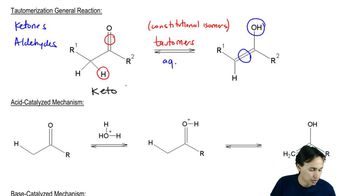
Tautomerism is a chemical phenomenon where two or more isomers, known as tautomers, exist in dynamic equilibrium, typically differing in the position of a proton and a double bond. In organic chemistry, the most common type is keto-enol tautomerism, where a ketone or aldehyde (keto form) can convert to an enol form, characterized by a hydroxyl group bonded to a carbon-carbon double bond.
추천 영상:
05:11
Tautomerization Mechanisms

Enol Stability

The stability of enol tautomers is influenced by factors such as hydrogen bonding, sterics, and resonance. Generally, enols are less stable than their keto counterparts due to the presence of a double bond and a hydroxyl group, which can lead to increased strain. However, certain enols can be stabilized by intramolecular hydrogen bonding or resonance effects, making them more favorable in specific contexts.
추천 영상:
02:26
Formation of Enolates

Drawing Tautomers

When drawing tautomers, it is essential to accurately depict the structural changes that occur during the tautomerization process. This includes the movement of protons and the formation or breaking of double bonds. Understanding the molecular structure and functional groups present in the compound is crucial for correctly identifying and illustrating the enol forms and determining their relative stability.
추천 영상:
04:48
Tautomers of Dicarbonyls