Ch. 17 - Reactions at the Alpha-Carbon
Bruice - Organic Chemistry 8th Edition
Bruice8th EditionOrganic ChemistryISBN: 9780135213711당신이 사용하는 게 아니라요?교과서 변경
17장, 문제 55a

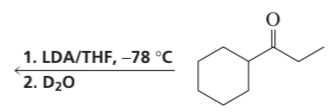
Draw the products of the following reactions:
a.

검증된 단계별 안내
1
Step 1: Identify the starting material, which is a ketone with a cyclopentane ring and a methyl group attached to the carbonyl carbon.
Step 2: Recognize the reagents used in the reaction. LDA (Lithium Diisopropylamide) is a strong, non-nucleophilic base, and THF (tetrahydrofuran) is the solvent. The reaction is performed at -78°C, which favors kinetic enolate formation.
Step 3: Understand the mechanism. LDA will deprotonate the most accessible alpha-hydrogen (hydrogen on the carbon adjacent to the carbonyl group) to form the kinetic enolate. The kinetic enolate is formed on the less substituted alpha-carbon due to steric hindrance.
Step 4: Analyze the second step. D₂O (deuterium oxide) is added, which will replace the enolate's alpha-hydrogen with a deuterium atom through protonation of the enolate intermediate.
Step 5: Draw the product. The final product will be the original ketone structure with a deuterium atom replacing the alpha-hydrogen on the less substituted alpha-carbon.

비슷한 문제에 대한 검증된 영상 답변:

이 영상 해법은 위 문제에 도움이 된다고 튜터들이 추천한 것입니다.
영상 길이:
4m

주요 개념

질문에 올바르게 답하기 위해 반드시 이해해야 하는 핵심 개념들은 다음과 같습니다.

Enolate Formation

Enolate formation is a key reaction in organic chemistry where a base abstracts a proton from an alpha carbon of a carbonyl compound, resulting in the formation of an enolate ion. This ion is resonance-stabilized and can act as a nucleophile in subsequent reactions. In the given reaction, LDA (Lithium diisopropylamide) is used as a strong base to generate the enolate at low temperatures, which is crucial for controlling the reaction pathway.
추천 영상:
02:26
Formation of Enolates

Aldol Reaction

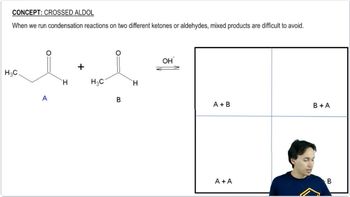
The aldol reaction involves the condensation of two carbonyl compounds, typically aldehydes or ketones, to form a β-hydroxy carbonyl compound. In this case, the enolate formed in the first step can attack another carbonyl carbon, leading to the formation of a new carbon-carbon bond. This reaction is fundamental in building complex organic molecules and is often followed by dehydration to yield α,β-unsaturated carbonyl compounds.
추천 영상:
09:51
Crossed Aldol

Deuterium Incorporation

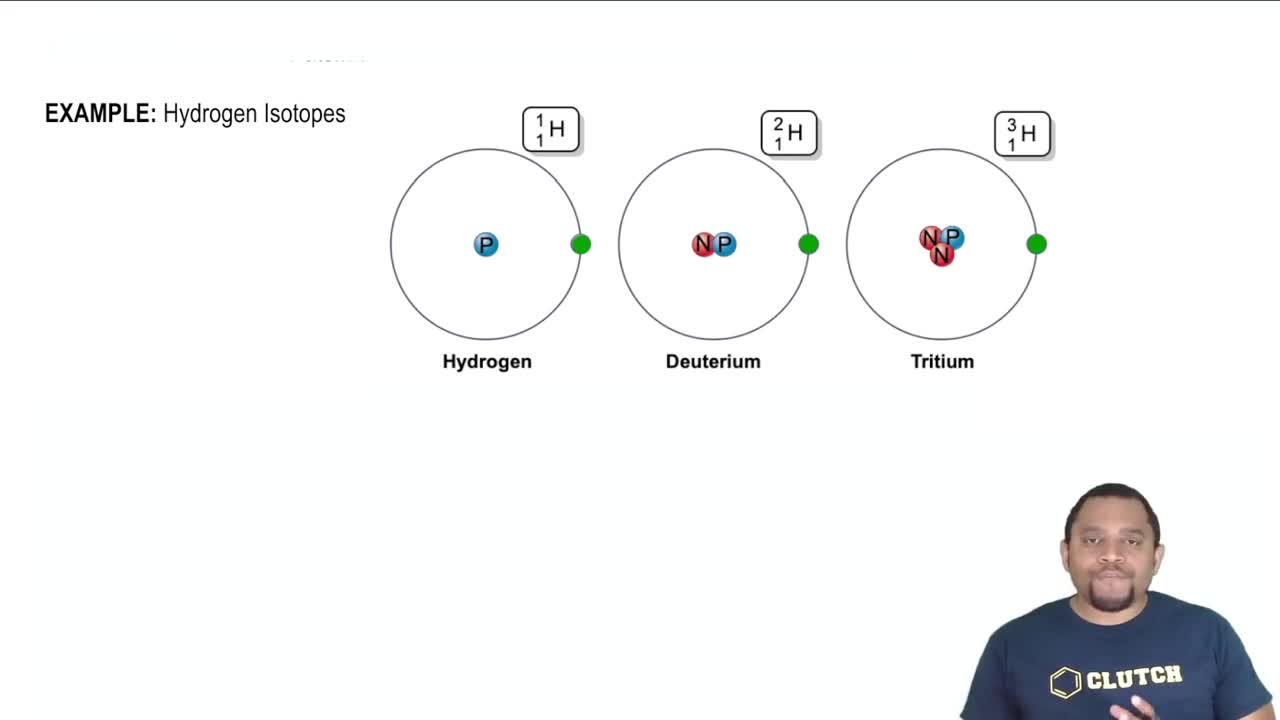
Deuterium incorporation refers to the introduction of deuterium (D or ²H), a stable isotope of hydrogen, into organic molecules. In the second step of the reaction, D₂O is used, allowing the enolate to react with deuterium instead of regular hydrogen. This process is significant in labeling studies and mechanistic investigations, as it can provide insights into reaction pathways and the behavior of intermediates.
추천 영상:
03:06
Understanding the hydrogen isotopes.