Ch. 17 - Reactions at the Alpha-Carbon
Bruice - Organic Chemistry 8th Edition
Bruice8th EditionOrganic ChemistryISBN: 9780135213711당신이 사용하는 게 아니라요?교과서 변경
17장, 문제 28b

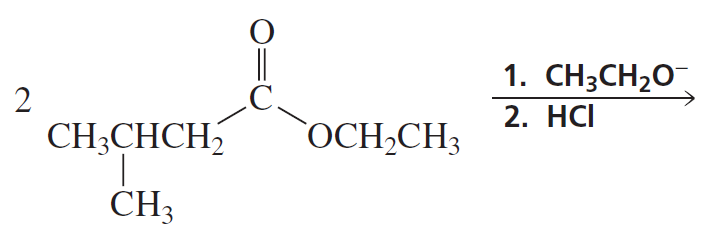
Draw the products of the following reactions:
b. Chemical structure showing a carbonyl group with two alkyl groups and reaction steps involving ethoxide and hydrochloric acid.

검증된 단계별 안내
1
Step 1: Analyze the starting material, which is an ester. The structure contains a carbonyl group (C=O) attached to an oxygen atom, and the oxygen is bonded to a methyl group. The ester is part of a larger alkyl chain with branching.
Step 2: The first reagent, CH3O⁻ (methoxide ion), acts as a nucleophile. It will attack the carbonyl carbon of the ester, leading to a nucleophilic acyl substitution reaction. This step involves breaking the bond between the carbonyl carbon and the oxygen atom of the ester group.
Step 3: After the nucleophilic attack, the intermediate formed will have a tetrahedral structure. The leaving group (methoxy group, CH3O) will be expelled, resulting in the formation of a carboxylate ion.
Step 4: The second reagent, HCl, is added to the reaction mixture. The acidic conditions will protonate the carboxylate ion, converting it into a carboxylic acid.
Step 5: The final product of the reaction will be a carboxylic acid with the same alkyl chain structure as the original ester, minus the methoxy group. The branching in the alkyl chain remains unchanged.

비슷한 문제에 대한 검증된 영상 답변:

이 영상 해법은 위 문제에 도움이 된다고 튜터들이 추천한 것입니다.
영상 길이:
14m

주요 개념

질문에 올바르게 답하기 위해 반드시 이해해야 하는 핵심 개념들은 다음과 같습니다.

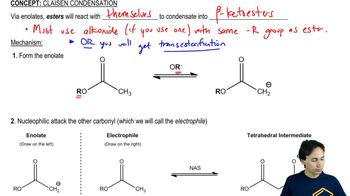
Claisen Condensation

The Claisen condensation is a reaction between two esters or an ester and a carbonyl compound in the presence of a strong base, leading to the formation of a β-keto ester or a β-diketone. This reaction involves the nucleophilic attack of an enolate ion on the carbonyl carbon of another ester, followed by the elimination of an alcohol. Understanding this mechanism is crucial for predicting the products of the reaction shown.
추천 영상:
08:28
Claisen Condensation

Enolate Ion Formation

Enolate ions are formed when a carbonyl compound, such as an ester, is deprotonated at the alpha carbon by a strong base. This ion acts as a nucleophile in various reactions, including the Claisen condensation. Recognizing how enolate ions are generated and their role in nucleophilic attacks is essential for understanding the reaction pathway and the final products.
추천 영상:
02:26
Formation of Enolates

Acid-Base Reactions

Acid-base reactions involve the transfer of protons (H+) between reactants, which can influence the outcome of organic reactions. In the context of the given reaction, HCl serves as an acid that can protonate the enolate ion or other intermediates, stabilizing the reaction products. A solid grasp of acid-base chemistry is necessary to predict how the addition of HCl will affect the final products of the Claisen condensation.
추천 영상:
02:49
The Lewis definition of acids and bases.