Ch. 17 - Reactions at the Alpha-Carbon
Bruice - Organic Chemistry 8th Edition
Bruice8th EditionOrganic ChemistryISBN: 9780135213711당신이 사용하는 게 아니라요?교과서 변경
17장, 문제 49e

Draw the products of the following reactions: e. diethyl malonate: (1) sodium ethoxide; (2) isobutyl bromide; (3) HCl, H2O + heat

검증된 단계별 안내
1
Step 1: Analyze the starting material, diethyl malonate. It contains two ester groups and a methylene group (-CH2-) between them, which is acidic due to the electron-withdrawing effects of the ester groups. This makes the methylene hydrogens susceptible to deprotonation by a base.
Step 2: In the first step, sodium ethoxide (CH3CH2ONa) acts as a strong base to deprotonate the methylene group of diethyl malonate, forming a carbanion. This carbanion is stabilized by resonance with the two ester groups.
Step 3: In the second step, the carbanion undergoes nucleophilic substitution with isobutyl bromide. The carbanion attacks the electrophilic carbon in the isobutyl bromide, displacing the bromide ion and forming a new C-C bond. This results in an alkylated diethyl malonate derivative.
Step 4: In the third step, the reaction mixture is treated with HCl, H2O, and heat. Under these conditions, the ester groups undergo hydrolysis to form carboxylic acids. The intermediate then undergoes decarboxylation (loss of CO2) due to heating, leaving behind a single carboxylic acid product.
Step 5: The final product is a substituted carboxylic acid where the original methylene group has been alkylated with the isobutyl group. The decarboxylation step ensures that only one carboxylic acid group remains in the product.

비슷한 문제에 대한 검증된 영상 답변:

이 영상 해법은 위 문제에 도움이 된다고 튜터들이 추천한 것입니다.
영상 길이:
6m

주요 개념

질문에 올바르게 답하기 위해 반드시 이해해야 하는 핵심 개념들은 다음과 같습니다.

Malonic Ester Synthesis

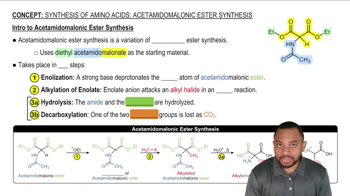
Malonic ester synthesis is a method for synthesizing carboxylic acids through the alkylation of diethyl malonate. In this reaction, diethyl malonate is first deprotonated by a strong base, such as sodium ethoxide, to form a nucleophilic enolate. This enolate can then react with an alkyl halide, such as isobutyl bromide, to form a substituted malonic ester, which can be hydrolyzed and decarboxylated to yield the desired carboxylic acid.
추천 영상:
가이드 코스
3:33
Synthesis of Amino Acids: Acetamidomalonic Ester Synthesis Concept 1

Enolate Formation

Enolate formation is a crucial step in many organic reactions, particularly in malonic ester synthesis. When a compound with an acidic hydrogen, like diethyl malonate, is treated with a strong base, it loses a proton to form an enolate ion. This enolate is a resonance-stabilized species that can act as a nucleophile, allowing it to attack electrophiles such as alkyl halides, facilitating the formation of new carbon-carbon bonds.
추천 영상:
02:26
Formation of Enolates

Hydrolysis and Decarboxylation

Hydrolysis and decarboxylation are key processes that follow the alkylation step in malonic ester synthesis. After the alkylation, the product is treated with acid and water, leading to hydrolysis, which converts the ester into a carboxylic acid. Subsequently, heating the carboxylic acid can induce decarboxylation, where carbon dioxide is released, resulting in the formation of a more stable product, typically a ketone or a simple carboxylic acid.
추천 영상:
가이드 코스
1:00
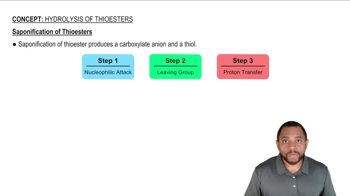
Hydrolysis of Thioesters Concept 2