Explain why hydroxide ion catalyzes the reaction of piperidine with 2,4-dinitroanisole but has no effect on the reaction of piperidine with 1-chloro-2,4-dinitrobenzene.
Ch. 18 - Reactions of Benzene and Substituted Benzenes
18장, 문제 98a
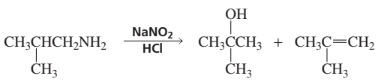
a. Explain why the following reaction leads to the products shown:

검증된 단계별 안내1
Step 1: Identify the type of reaction taking place. Determine whether it is a substitution, elimination, addition, or rearrangement reaction. This will help in understanding the mechanism and why the products are formed.
Step 2: Analyze the reactants and reagents involved. Look at the functional groups present in the starting material and the nature of the reagent (e.g., nucleophile, electrophile, acid, or base). This will provide clues about the reaction pathway.
Step 3: Consider the reaction mechanism. For example, if it is a substitution reaction, determine whether it follows an SN1 or SN2 mechanism. If it is an elimination reaction, decide whether it proceeds via an E1 or E2 pathway. Use the structure of the reactants and reaction conditions to justify the mechanism.
Step 4: Examine the stability of the intermediates and products. For example, in an SN1 reaction, the formation of a stable carbocation intermediate can explain why a particular product is favored. Similarly, in elimination reactions, the Zaitsev rule (formation of the more substituted alkene) often predicts the major product.
Step 5: Relate the reaction conditions to the observed products. For instance, if the reaction occurs under acidic or basic conditions, this can influence the pathway and the final products. Summarize how the mechanism and conditions lead to the specific products shown.

비슷한 문제에 대한 검증된 영상 답변:
이 영상 해법은 위 문제에 도움이 된다고 튜터들이 추천한 것입니다.
주요 개념
질문에 올바르게 답하기 위해 반드시 이해해야 하는 핵심 개념들은 다음과 같습니다.
Reaction Mechanism
A reaction mechanism describes the step-by-step sequence of elementary reactions by which overall chemical change occurs. Understanding the mechanism helps in predicting the products formed in a reaction, as it outlines how reactants interact, transition states, and the formation of intermediates. This knowledge is crucial for explaining why specific products are generated.
추천 영상:
Heck Reaction Mechanism
Functional Groups
Functional groups are specific groups of atoms within molecules that are responsible for the characteristic chemical reactions of those molecules. Recognizing the functional groups present in the reactants and products allows chemists to predict reactivity patterns and the types of transformations that can occur during a reaction, which is essential for explaining the observed products.
추천 영상:
Identifying Functional Groups
Thermodynamics and Kinetics
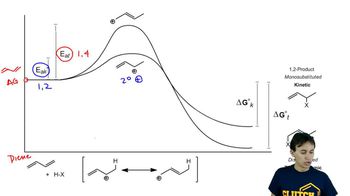
Thermodynamics and kinetics are two fundamental concepts in chemistry that explain the feasibility and rate of reactions, respectively. Thermodynamics assesses the energy changes and stability of reactants and products, while kinetics focuses on the speed of the reaction and the factors affecting it. Together, they provide insight into why a reaction proceeds to form specific products under given conditions.
추천 영상:
Kinetic vs. Thermodynamic Control
관련 실천
교과서 질문
468
views
교과서 질문
Tyramine is an alkaloid found in mistletoe and ripe cheese. Dopamine is a neurotransmitter involved in the regulation of the central nervous system.
a. How can tyramine be prepared from b-phenylethylamine?
827
views
교과서 질문
Propose a mechanism for the following reaction that explains why the configuration of the asymmetric center in the reactant is retained in the product:
1356
views
교과서 질문
Describe how 3-methyl-1-phenyl-3-pentanol can be prepared from benzene. You can use any inorganic reagents and solvents, and any organic reagents provided they contain no more than two carbons.
1135
views
교과서 질문
Propose a mechanism for each of the following reactions:
b.
992
views