Ch. 18 - Reactions of Benzene and Substituted Benzenes
Bruice - Organic Chemistry 8th Edition
Bruice8th EditionOrganic ChemistryISBN: 9780135213711당신이 사용하는 게 아니라요?교과서 변경
18장, 문제 45f

Draw the structure for each of the following:
f. m-chlorostyrene

검증된 단계별 안내
1
Identify the parent structure: The parent structure is 'styrene,' which consists of a benzene ring attached to an ethene group (C6H5-CH=CH2).
Understand the prefix 'm-chloro': The 'm-' (meta) position indicates that the chlorine atom is attached to the benzene ring at the position that is one carbon away from the ethene group, skipping the adjacent carbon (para and ortho positions are not used here).
Number the benzene ring: Assign the carbon attached to the ethene group as position 1. The meta position corresponds to position 3 on the benzene ring.
Add the chlorine substituent: Place a chlorine atom (Cl) at the meta position (position 3) of the benzene ring.
Draw the final structure: Combine the benzene ring with the ethene group at position 1 and the chlorine atom at position 3 to complete the structure of m-chlorostyrene.

비슷한 문제에 대한 검증된 영상 답변:

이 영상 해법은 위 문제에 도움이 된다고 튜터들이 추천한 것입니다.
영상 길이:
2m

주요 개념

질문에 올바르게 답하기 위해 반드시 이해해야 하는 핵심 개념들은 다음과 같습니다.

Aromatic Compounds

Aromatic compounds are a class of cyclic compounds that contain conjugated pi electron systems, which follow Huckel's rule (4n + 2 pi electrons). They are characterized by their stability and unique reactivity due to resonance. Understanding the structure of aromatic compounds is essential for drawing and predicting the behavior of compounds like m-chlorostyrene.
추천 영상:
08:19
Intro to Aromaticity

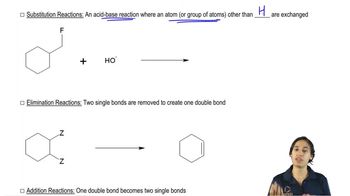
Substitution Reactions

Substitution reactions in organic chemistry involve the replacement of one atom or group in a molecule with another. In the case of m-chlorostyrene, the chlorine atom is a substituent on the aromatic ring. Recognizing how substituents affect the reactivity and stability of aromatic compounds is crucial for accurately representing their structures.
추천 영상:
01:34
Recognizing Substitution Reactions.

Styrene Structure

Styrene is an aromatic hydrocarbon with a vinyl group (–CH=CH2) attached to a benzene ring. The presence of the vinyl group influences the reactivity of the compound, particularly in polymerization reactions. Understanding the basic structure of styrene is vital for drawing derivatives like m-chlorostyrene, where a chlorine atom is positioned on the meta position relative to the vinyl group.
추천 영상:
03:04
Drawing Resonance Structures