Ch. 18 - Reactions of Benzene and Substituted Benzenes
Bruice - Organic Chemistry 8th Edition
Bruice8th EditionOrganic ChemistryISBN: 9780135213711당신이 사용하는 게 아니라요?교과서 변경
18장, 문제 42g,h,i

Draw the structure for each of the following:
g. toluene
h. tert-butylbenzene
i. benzyl chloride

검증된 단계별 안내
1
Step 1: Understand the problem. You are tasked with drawing the structures of three organic compounds: toluene, tert-butylbenzene, and benzyl chloride. Each of these compounds is derived from benzene, a six-membered aromatic ring with alternating double bonds.
Step 2: Draw the structure of toluene. Toluene is a benzene ring with a single methyl group (-CH₃) attached to one of the carbons on the ring. Represent the benzene ring as a hexagon with alternating double bonds, and attach the methyl group to one of the carbons.
Step 3: Draw the structure of tert-butylbenzene. Tert-butylbenzene is a benzene ring with a tert-butyl group attached. A tert-butyl group is a carbon atom bonded to three methyl groups (-C(CH₃)₃). Attach this bulky group to one of the carbons on the benzene ring.
Step 4: Draw the structure of benzyl chloride. Benzyl chloride is a benzene ring with a -CH₂Cl group attached. The -CH₂Cl group consists of a methylene group (-CH₂-) bonded to a chlorine atom. Attach this group to one of the carbons on the benzene ring.
Step 5: Verify your structures. Ensure that each structure adheres to the rules of valency and that the substituents are correctly attached to the benzene ring. Double-check the placement of the functional groups and confirm that the aromaticity of the benzene ring is preserved in all cases.

비슷한 문제에 대한 검증된 영상 답변:

이 영상 해법은 위 문제에 도움이 된다고 튜터들이 추천한 것입니다.
영상 길이:
2m

주요 개념

질문에 올바르게 답하기 위해 반드시 이해해야 하는 핵심 개념들은 다음과 같습니다.

Aromatic Compounds

Aromatic compounds are a class of cyclic compounds that follow Huckel's rule, which states that they must have a planar structure with a specific number of pi electrons (4n + 2, where n is a non-negative integer). These compounds exhibit unique stability due to resonance, making them less reactive than aliphatic compounds. Toluene, tert-butylbenzene, and benzyl chloride are all examples of aromatic compounds, characterized by their benzene ring structure.
추천 영상:
08:19
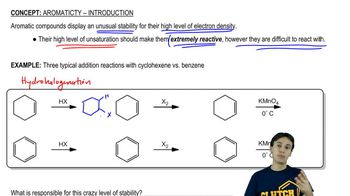
Intro to Aromaticity

Substituted Benzene Derivatives

Substituted benzene derivatives are compounds where one or more hydrogen atoms of the benzene ring are replaced by other functional groups or alkyl chains. The nature and position of these substituents can significantly influence the chemical properties and reactivity of the compound. For instance, toluene has a methyl group as a substituent, while tert-butylbenzene has a bulky tert-butyl group, affecting their physical and chemical behavior.
추천 영상:
09:04
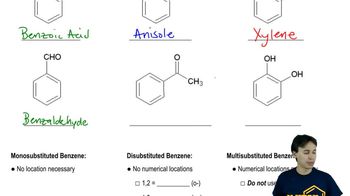
Benzene Nomenclature

Halogenation of Aromatic Compounds

Halogenation is a chemical reaction where a halogen atom is introduced into an organic compound. In the case of benzyl chloride, a benzyl group (C6H5CH2-) is bonded to a chlorine atom, resulting from the substitution of a hydrogen atom on the benzyl carbon. This process is important in organic synthesis, as it allows for the introduction of reactive halogen atoms that can participate in further chemical reactions.
추천 영상:
08:19
Intro to Aromaticity