Ch. 18 - Reactions of Benzene and Substituted Benzenes
Bruice - Organic Chemistry 8th Edition
Bruice8th EditionOrganic ChemistryISBN: 9780135213711당신이 사용하는 게 아니라요?교과서 변경
18장, 문제 24i

Show how each of the following compounds can be synthesized from benzene:
i. 1-phenyl-2-propanol

검증된 단계별 안내
1
Step 1: Begin with benzene as the starting material. Perform a Friedel-Crafts alkylation reaction using 2-chloropropane and AlCl₃ as the catalyst. This introduces an isopropyl group onto the benzene ring, forming isopropylbenzene (cumene).
Step 2: Oxidize the isopropyl group on the benzene ring to form acetophenone (C₆H₅COCH₃). This can be achieved using an oxidizing agent such as chromic acid (H₂CrO₄).
Step 3: Reduce the carbonyl group in acetophenone to form 1-phenyl-2-propanol. Use a reducing agent such as sodium borohydride (NaBH₄) or lithium aluminum hydride (LiAlH₄) to convert the ketone group into a secondary alcohol.
Step 4: Purify the product using techniques such as recrystallization or distillation to isolate 1-phenyl-2-propanol.
Step 5: Confirm the structure of the synthesized compound using spectroscopic methods such as NMR or IR to ensure the correct product has been obtained.

비슷한 문제에 대한 검증된 영상 답변:

이 영상 해법은 위 문제에 도움이 된다고 튜터들이 추천한 것입니다.
영상 길이:
8m

주요 개념

질문에 올바르게 답하기 위해 반드시 이해해야 하는 핵심 개념들은 다음과 같습니다.

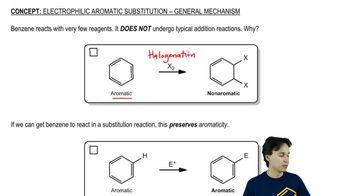
Electrophilic Aromatic Substitution (EAS)

Electrophilic Aromatic Substitution is a fundamental reaction in organic chemistry where an electrophile replaces a hydrogen atom on an aromatic ring, such as benzene. This reaction is crucial for synthesizing various aromatic compounds, as it allows for the introduction of different functional groups onto the benzene ring, which can then be further modified to create complex molecules.
추천 영상:
03:07
EAS Review

Grignard Reagents

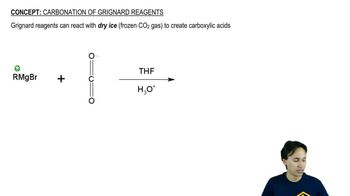
Grignard reagents are organomagnesium compounds that are highly reactive and used to form carbon-carbon bonds. They are synthesized by reacting magnesium with an alkyl or aryl halide. In the context of synthesizing 1-phenyl-2-propanol, a Grignard reagent can react with a carbonyl compound to produce an alcohol, demonstrating their utility in building larger organic molecules.
추천 영상:
02:12
Carbonation of Grignard Reagents

Reduction Reactions

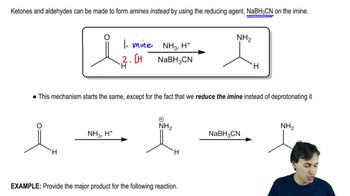
Reduction reactions involve the gain of electrons or the decrease in oxidation state of a molecule, often resulting in the formation of alcohols from carbonyl compounds. In the synthesis of 1-phenyl-2-propanol, a ketone or aldehyde intermediate can be reduced using reducing agents like lithium aluminum hydride (LiAlH4) or sodium borohydride (NaBH4) to yield the desired alcohol product.
추천 영상:
07:12
Reductive Amination