Ch. 18 - Reactions of Benzene and Substituted Benzenes
Bruice - Organic Chemistry 8th Edition
Bruice8th EditionOrganic ChemistryISBN: 9780135213711당신이 사용하는 게 아니라요?교과서 변경
18장, 문제 24a

Show how each of the following compounds can be synthesized from benzene:
a. o-bromopropylbenzene

검증된 단계별 안내
1
Step 1: Begin with benzene as the starting material. To introduce a bromine atom at the ortho position relative to the propyl group, you need to first add the propyl group to benzene. This can be achieved through a Friedel-Crafts alkylation reaction. React benzene with propyl chloride (CH3CH2CH2Cl) in the presence of a Lewis acid catalyst such as AlCl3 to form propylbenzene.
Step 2: Once you have propylbenzene, the next step is to brominate the benzene ring. Bromination of benzene is typically carried out using bromine (Br2) in the presence of a catalyst such as FeBr3. However, this reaction will produce a mixture of ortho, meta, and para isomers due to the directing effects of the propyl group.
Step 3: The propyl group is an electron-donating group, which activates the benzene ring and directs incoming electrophiles to the ortho and para positions. To maximize the formation of the ortho isomer (o-bromopropylbenzene), you can use reaction conditions that favor ortho substitution, such as controlling the temperature and using a slight excess of bromine.
Step 4: After the bromination reaction, separate the desired ortho isomer (o-bromopropylbenzene) from the mixture of isomers. This can be done using techniques such as fractional distillation or chromatography.
Step 5: Verify the structure of the synthesized o-bromopropylbenzene using spectroscopic methods such as NMR (nuclear magnetic resonance) and IR (infrared spectroscopy) to confirm the presence of the bromine atom at the ortho position relative to the propyl group.

비슷한 문제에 대한 검증된 영상 답변:

이 영상 해법은 위 문제에 도움이 된다고 튜터들이 추천한 것입니다.
영상 길이:
10m

주요 개념

질문에 올바르게 답하기 위해 반드시 이해해야 하는 핵심 개념들은 다음과 같습니다.

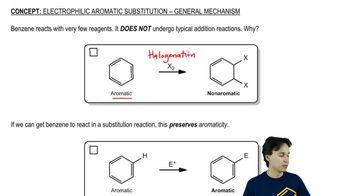
Electrophilic Aromatic Substitution

Electrophilic aromatic substitution (EAS) is a fundamental reaction in organic chemistry where an electrophile replaces a hydrogen atom on an aromatic ring. This process is crucial for synthesizing various aromatic compounds, including derivatives of benzene. Understanding the mechanism of EAS, including the formation of the sigma complex and the role of catalysts, is essential for predicting the products of reactions involving benzene.
추천 영상:
03:07
EAS Review

Bromination of Aromatic Compounds

Bromination is a specific type of electrophilic aromatic substitution where bromine acts as the electrophile. In the presence of a Lewis acid catalyst, such as FeBr3, bromine can effectively add to the benzene ring. This reaction is important for introducing bromine into the aromatic system, which can then be further modified to create compounds like o-bromopropylbenzene through subsequent reactions.
추천 영상:
00:54
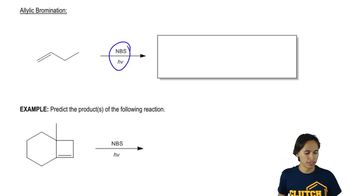
Mechanism of Allylic Bromination.

Alkylation of Aromatic Compounds

Alkylation involves the introduction of an alkyl group into an aromatic compound, often through Friedel-Crafts alkylation. This reaction typically uses an alkyl halide and a strong Lewis acid catalyst. Understanding how to control regioselectivity and avoid polysubstitution is vital for synthesizing specific alkyl-substituted aromatic compounds, such as o-bromopropylbenzene from benzene.
추천 영상:
08:19
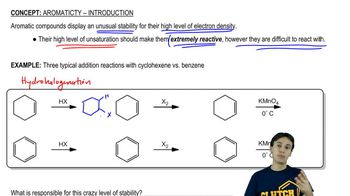
Intro to Aromaticity