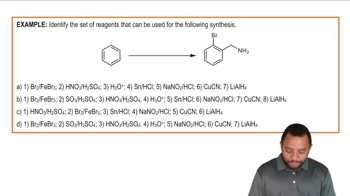
Why isn’t FeBr3 used as a catalyst in the first step of the synthesis of 1,3,5-tribromobenzene?
Ch. 18 - Reactions of Benzene and Substituted Benzenes
18장, 문제 32
What product is formed from the reaction of p-methylphenol with benzenediazonium chloride?
검증된 단계별 안내1
Step 1: Recognize the type of reaction. This is an example of an electrophilic aromatic substitution reaction, specifically a diazo coupling reaction, where benzenediazonium chloride acts as an electrophile and p-methylphenol acts as a nucleophile.
Step 2: Identify the reactive site on p-methylphenol. The hydroxyl (-OH) group on the phenol ring is an activating group that increases electron density on the aromatic ring, especially at the ortho and para positions relative to the -OH group. Since the methyl group is already at the para position, the coupling will likely occur at the ortho position.
Step 3: Understand the mechanism. The diazonium ion (N≡N⁺) from benzenediazonium chloride attacks the electron-rich ortho position of p-methylphenol, forming a new bond between the aromatic ring of p-methylphenol and the diazonium group.
Step 4: Consider resonance stabilization. The resulting product will have conjugation between the aromatic ring and the azo (-N=N-) group, which stabilizes the molecule. This conjugation is responsible for the vibrant colors of azo compounds.
Step 5: Name the product. The final product is an azo compound, specifically 2-(p-methylphenylazo)-p-methylphenol, where the azo group (-N=N-) connects the p-methylphenol and the benzene ring from benzenediazonium chloride.

비슷한 문제에 대한 검증된 영상 답변:
이 영상 해법은 위 문제에 도움이 된다고 튜터들이 추천한 것입니다.
영상 길이:
3m주요 개념
질문에 올바르게 답하기 위해 반드시 이해해야 하는 핵심 개념들은 다음과 같습니다.
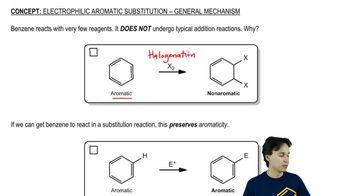
Electrophilic Aromatic Substitution
Electrophilic aromatic substitution (EAS) is a fundamental reaction in organic chemistry where an electrophile replaces a hydrogen atom on an aromatic ring. In this context, benzenediazonium chloride acts as the electrophile, which can react with the electron-rich p-methylphenol, leading to the substitution of a hydrogen atom on the aromatic ring.
추천 영상:
EAS Review
Aromatic Compounds
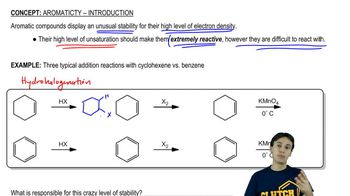
Aromatic compounds are a class of cyclic compounds characterized by their stable ring structure and delocalized π-electrons. p-Methylphenol, also known as p-cresol, is an aromatic compound that contains a hydroxyl group (-OH) and a methyl group (-CH3) attached to a benzene ring, influencing its reactivity in electrophilic substitution reactions.
추천 영상:
Intro to Aromaticity
Diazonium Salts
Diazonium salts are highly reactive intermediates in organic synthesis, formed by the reaction of primary aromatic amines with nitrous acid. Benzenediazonium chloride is a common diazonium salt that can participate in various coupling reactions, including those with aromatic compounds like p-methylphenol, resulting in the formation of azo compounds.
추천 영상:
가이드 코스
Review of Nitriles Example 5
관련 실천
교과서 질문
1300
views
교과서 질문
Draw the structure of the activated benzene ring and the diazonium ion used in the synthesis of each of the following compounds, whose structures can be found on page 607.
b. methyl orange
1114
views
교과서 질문
Show how the following compounds can be synthesized from benzene:
d. m-methylnitrobenzene
1136
views
교과서 질문
In the mechanism for electrophilic aromatic substitution with a diazonium ion as the electrophile, why does nucleophilic attack occur on the terminal nitrogen of the diazonium ion rather than on the nitrogen that has the formal positive charge?
1110
views
교과서 질문
Which amide bond is hydrolyzed in the first step of the conversion of temozolomide to methyldiazonium?
802
views
교과서 질문
Explain why a diazonium group on a benzene ring cannot be used to direct an incoming substituent to the meta position.
908
views