Ch. 18 - Reactions of Benzene and Substituted Benzenes
Bruice - Organic Chemistry 8th Edition
Bruice8th EditionOrganic ChemistryISBN: 9780135213711당신이 사용하는 게 아니라요?교과서 변경
18장, 문제 90

When heated with chromic acid, compound A forms benzoic acid. Identify compound A from its 1H NMR spectrum.
<IMAGE>

검증된 단계별 안내
1
Step 1: Analyze the 1H NMR spectrum provided. The spectrum shows two distinct signals: one at approximately 7 ppm and another at approximately 2 ppm. The integration values indicate a ratio of 2:3 for these signals.
Step 2: The signal at 7 ppm corresponds to aromatic protons, which are characteristic of a benzene ring. This suggests that compound A contains an aromatic ring.
Step 3: The signal at 2 ppm corresponds to protons in a methyl group (-CH3) attached to the aromatic ring. This indicates that compound A likely has a methyl group directly bonded to the benzene ring.
Step 4: When heated with chromic acid, compound A forms benzoic acid. Chromic acid is a strong oxidizing agent that oxidizes methyl groups attached to aromatic rings into carboxylic acids (-COOH). This confirms that compound A is toluene (methylbenzene).
Step 5: To summarize, the 1H NMR spectrum and the reaction with chromic acid indicate that compound A is toluene, which upon oxidation forms benzoic acid.

비슷한 문제에 대한 검증된 영상 답변:

이 영상 해법은 위 문제에 도움이 된다고 튜터들이 추천한 것입니다.
영상 길이:
8m

주요 개념

질문에 올바르게 답하기 위해 반드시 이해해야 하는 핵심 개념들은 다음과 같습니다.

NMR Spectroscopy

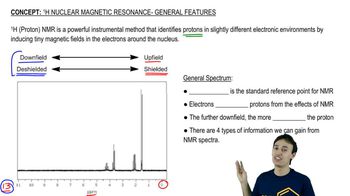
Nuclear Magnetic Resonance (NMR) spectroscopy is a powerful analytical technique used to determine the structure of organic compounds. It provides information about the number of hydrogen atoms in different environments within a molecule, indicated by peaks in the spectrum. The chemical shift, measured in parts per million (PPM), reveals the electronic environment of the hydrogen atoms, helping to identify functional groups and molecular structure.
추천 영상:
10:06
General NMR Features

Chromic Acid Oxidation

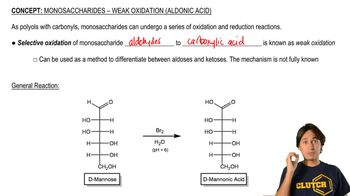
Chromic acid is a strong oxidizing agent commonly used in organic chemistry to oxidize alcohols to carbonyl compounds and further to carboxylic acids. In this context, the oxidation of compound A to benzoic acid suggests that compound A is likely a primary or secondary alcohol or an aldehyde. Understanding this reaction is crucial for deducing the structure of compound A based on its transformation.
추천 영상:
04:15
Monosaccharides - Weak Oxidation (Aldonic Acid)

Chemical Shifts in Aromatic Compounds

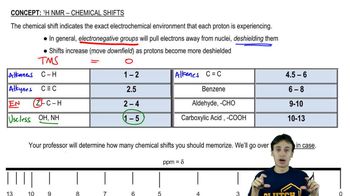
In NMR spectroscopy, aromatic protons typically resonate in the range of 6.5 to 8.5 PPM due to the deshielding effect of the aromatic ring. The presence of peaks at specific PPM values can indicate the number of hydrogen atoms on the aromatic ring and their relative positions. Analyzing these shifts helps in identifying the substitution pattern on the aromatic compound, which is essential for determining the structure of compound A.
추천 영상:
11:44
1H NMR Chemical Shifts