Ch. 19 - More About Amines • Reactions of Heterocyclic Compounds
Bruice - Organic Chemistry 8th Edition
Bruice8th EditionOrganic ChemistryISBN: 9780135213711당신이 사용하는 게 아니라요?교과서 변경
19장, 문제 13

Rank the following compounds from easiest to hardest at removing a proton from its methyl substituent:

검증된 단계별 안내
1
Step 1: Analyze the chemical structures provided. The compounds are pyridine derivatives with methyl substituents. The first compound is 2-methylpyridine, the second is 4-methylpyridine, and the third is 2-methylpyridinium iodide.
Step 2: Consider the factors affecting the acidity of the methyl group. The ease of removing a proton from the methyl group depends on the stability of the resulting carbanion. Electron-withdrawing groups or resonance stabilization can increase the acidity.
Step 3: Evaluate the influence of the nitrogen atom in the pyridine ring. In 2-methylpyridine and 4-methylpyridine, the nitrogen atom can stabilize the carbanion formed after deprotonation through resonance. However, the position of the methyl group relative to the nitrogen affects the extent of stabilization.
Step 4: Examine the third compound, 2-methylpyridinium iodide. The positively charged nitrogen in the pyridinium ring significantly reduces the electron density, making the methyl group less acidic compared to the neutral pyridine derivatives.
Step 5: Rank the compounds based on the ease of removing a proton from the methyl group. Consider the resonance effects and the electron-withdrawing nature of the nitrogen atom in each case. The order is likely: 4-methylpyridine (most acidic), 2-methylpyridine, and 2-methylpyridinium iodide (least acidic).

비슷한 문제에 대한 검증된 영상 답변:

이 영상 해법은 위 문제에 도움이 된다고 튜터들이 추천한 것입니다.
영상 길이:
9m

주요 개념

질문에 올바르게 답하기 위해 반드시 이해해야 하는 핵심 개념들은 다음과 같습니다.

Acidity and pKa

Acidity refers to the tendency of a compound to donate a proton (H+). The strength of an acid is often measured by its pKa value; lower pKa values indicate stronger acids. Understanding the pKa of the compounds in question is essential for ranking them based on how easily they can lose a proton from their methyl substituent.
추천 영상:
07:45
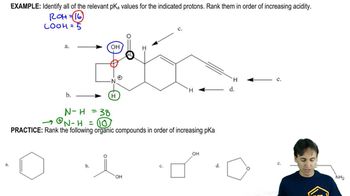
Identifying pKa values

Inductive Effect

The inductive effect describes how the presence of electronegative atoms or groups can stabilize or destabilize a negative charge in a molecule. Electron-withdrawing groups can increase acidity by stabilizing the conjugate base formed after deprotonation, while electron-donating groups can decrease acidity. Recognizing these effects is crucial for predicting the ease of proton removal.
추천 영상:
01:47
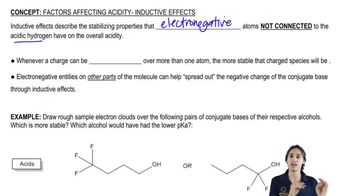
Understanding the Inductive Effect.

Resonance Stabilization

Resonance stabilization occurs when a molecule can distribute its electron density across multiple structures, leading to increased stability. In the context of acidity, if the conjugate base formed after deprotonation can be resonance-stabilized, it will be more favorable for the compound to lose a proton. This concept is vital for understanding the relative acidity of the compounds being compared.
추천 영상:
03:43
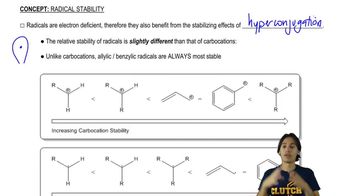
The radical stability trend.