Butyric acid, the compound responsible for the unpleasant odor and taste of sour milk, has a pKa value of 4.82. What is its Ka value? Is it a stronger acid or a weaker acid than vitamin C?
Ch. 2 - Acids and Bases: Central to Understanding Organic Chemistry
2장, 문제 5ab
a. Which is a stronger acid: one with a pKa of 5.2 or one with a pKa of 5.8?
b. Which is a stronger acid: one with an acid dissociation constant of 3.4 × 10⁻³ or one with an acid dissociation constant of 2.1 × 10⁻⁴?
검증된 단계별 안내1
Step 1: Understand the relationship between pKa and acid strength. The lower the pKa value, the stronger the acid. This is because pKa is inversely related to the acid dissociation constant (Ka), which measures the extent of ionization of the acid in solution.
Step 2: Compare the pKa values given in part (a). The acid with a pKa of 5.2 is lower than the acid with a pKa of 5.8, indicating that the acid with a pKa of 5.2 is stronger.
Step 3: Understand the relationship between Ka and acid strength for part (b). The higher the Ka value, the stronger the acid. This is because a larger Ka indicates greater ionization of the acid in solution.
Step 4: Compare the Ka values given in part (b). The acid with a Ka of 3.4×10⁻³ is larger than the acid with a Ka of 2.1×10⁻⁴, indicating that the acid with a Ka of 3.4×10⁻³ is stronger.
Step 5: Summarize the findings: For part (a), the acid with a pKa of 5.2 is stronger. For part (b), the acid with a Ka of 3.4×10⁻³ is stronger. This demonstrates the inverse relationship between pKa and Ka when determining acid strength.

비슷한 문제에 대한 검증된 영상 답변:
이 영상 해법은 위 문제에 도움이 된다고 튜터들이 추천한 것입니다.
영상 길이:
4m주요 개념
질문에 올바르게 답하기 위해 반드시 이해해야 하는 핵심 개념들은 다음과 같습니다.
pKa and Acid Strength
The pKa value is a logarithmic measure of the acidity of a substance, where a lower pKa indicates a stronger acid. This is because pKa is derived from the acid dissociation constant (Ka), which quantifies the extent to which an acid donates protons in solution. Therefore, comparing pKa values allows us to determine which acid is stronger based on their numerical values.
추천 영상:
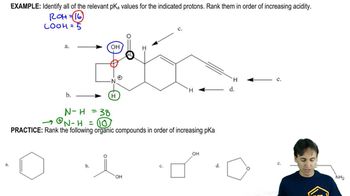
Identifying pKa values
Acid Dissociation Constant (Ka)
The acid dissociation constant (Ka) is a quantitative measure of the strength of an acid in solution. It represents the equilibrium constant for the dissociation of an acid into its conjugate base and a proton. A larger Ka value indicates a stronger acid, as it signifies a greater tendency to lose protons, making it essential for comparing acid strengths directly.
추천 영상:
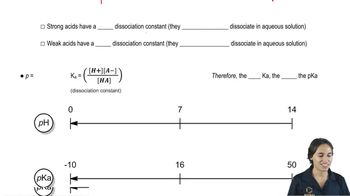
The relationship between equilibrium constant and pKa.
Relationship Between pKa and Ka
The relationship between pKa and Ka is expressed by the equation pKa = -log(Ka). This means that as the Ka increases, the pKa decreases, reinforcing the idea that stronger acids have lower pKa values. Understanding this relationship is crucial for interpreting acid strength comparisons, as it allows for the conversion between the two measures and aids in determining which acid is stronger.
추천 영상:
The relationship between equilibrium constant and pKa.
관련 실천
교과서 질문
932
views
교과서 질문
What is the conjugate base of each of the following?
1. NH3
2. HBr
3. HNO3
4. H2O
1389
views
교과서 질문
Antacids are compounds that neutralize stomach acid. Write the equations that show how Milk of Magnesia, Alka-Seltzer, and Tums remove excess acid.
a. Milk of Magnesia: Mg(OH)2
b. Alka-Seltzer: KHCO3 and NaHCO3
c. Tums: CaCO3
2410
views
교과서 질문
What is the conjugate acid of each of the following?
1. NH3
2. Cl−
3. HO−
4. H2O
1887
views
교과서 질문
An acid has a Ka of 4.53 × 10⁻⁶ in water. What is its Keq for reaction with water in a dilute solution? ([H2O] = 55.5 M)
1574
views
교과서 질문
Consider the following reaction:
HBr + -C≡N ⇌ Br− + HC≡N
g. What is the conjugate base of the acid on the right?
h. What is the conjugate acid of the base on the right?
1201
views