Ch. 2 - Acids and Bases: Central to Understanding Organic Chemistry
Bruice - Organic Chemistry 8th Edition
Bruice8th EditionOrganic ChemistryISBN: 9780135213711당신이 사용하는 게 아니라요?교과서 변경
2장, 문제 72b

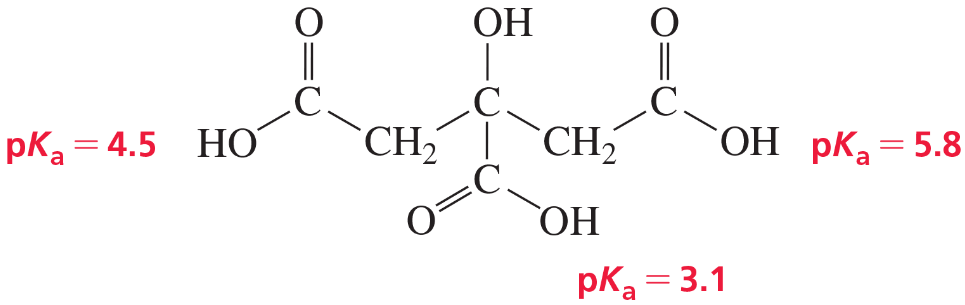
Citrus fruits are rich in citric acid, a compound with three COOH groups. Explain the following:
b. The third pKa is greater than the pKa of acetic acid.

검증된 단계별 안내
1
Step 1: Understand the structure of citric acid. Citric acid is a tricarboxylic acid with three carboxylic acid (-COOH) groups. Each -COOH group has a different pKa value due to the influence of the molecule's structure and the interactions between the groups.
Step 2: Compare the third pKa of citric acid (5.8) with the pKa of acetic acid (4.76). The pKa value indicates the strength of an acid; a higher pKa means the acid is weaker. The third -COOH group in citric acid is less acidic than acetic acid.
Step 3: Consider the electronic effects within citric acid. When the first and second -COOH groups lose their protons, the molecule becomes negatively charged. This negative charge creates electrostatic repulsion, making it harder for the third -COOH group to lose its proton, thus increasing its pKa value.
Step 4: Compare acetic acid's structure. Acetic acid has only one -COOH group, so there are no additional negative charges or intramolecular interactions to stabilize the conjugate base. This makes acetic acid more acidic than the third -COOH group in citric acid.
Step 5: Summarize the reasoning. The third pKa of citric acid is greater than the pKa of acetic acid because the negative charges on the conjugate base of citric acid after losing two protons create repulsion, making it harder for the third proton to dissociate. This effect is absent in acetic acid, which has only one -COOH group.

비슷한 문제에 대한 검증된 영상 답변:

이 영상 해법은 위 문제에 도움이 된다고 튜터들이 추천한 것입니다.
영상 길이:
4m

주요 개념

질문에 올바르게 답하기 위해 반드시 이해해야 하는 핵심 개념들은 다음과 같습니다.

pKa and Acid Strength

pKa is a measure of the acidity of a compound, indicating the strength of an acid in solution. A lower pKa value corresponds to a stronger acid, as it reflects a greater tendency to donate protons (H+ ions). Understanding pKa is essential for comparing the acidity of different compounds, such as citric acid and acetic acid.
추천 영상:
07:45
Identifying pKa values

Citric Acid Structure

Citric acid is a tricarboxylic acid, meaning it contains three carboxyl (COOH) groups. The presence of multiple acidic protons allows for multiple dissociation steps, each with its own pKa value. The structure of citric acid influences its acidity, as the electron-withdrawing effects of the other carboxyl groups can stabilize the negative charge on the conjugate base formed after deprotonation.
추천 영상:
가이드 코스
1:05
Citric Acid Cycle Structures Concept 1

Comparative Acidity of Acids

When comparing the acidity of citric acid and acetic acid, it is important to consider the number of acidic protons and the stability of their conjugate bases. The third pKa of citric acid being greater than that of acetic acid suggests that the third proton is less easily lost, indicating that the corresponding conjugate base is less stable compared to that of acetic acid, which has only one acidic proton.
추천 영상:
02:41
Comparing hydrocarbon acidity