Ch. 2 - Acids and Bases: Central to Understanding Organic Chemistry
Bruice - Organic Chemistry 8th Edition
Bruice8th EditionOrganic ChemistryISBN: 9780135213711당신이 사용하는 게 아니라요?교과서 변경
2장, 문제 10a,b,c

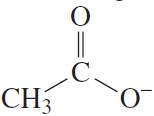
Draw the conjugate acid of each of the following:
a. CH3CH2OH
b. CH3CH2O−
c. Structural formula of an ethoxide ion showing the carbon atom bonded to a negatively charged oxygen and a methyl group.

검증된 단계별 안내
1
Identify the concept of a conjugate acid: A conjugate acid is formed when a base accepts a proton (H⁺). For each compound, determine the site where a proton can be added.
For CH₃CH₂OH (ethanol): The molecule contains an -OH group, which can act as a base. Add a proton (H⁺) to the oxygen atom, resulting in CH₃CH₂OH₂⁺. This is the conjugate acid of ethanol.
For CH₃CH₂O⁻ (ethoxide ion): The molecule is already negatively charged, indicating it is a strong base. Add a proton (H⁺) to the oxygen atom, neutralizing the negative charge and forming CH₃CH₂OH. This is the conjugate acid of the ethoxide ion.
Draw the structures of the conjugate acids: For CH₃CH₂OH₂⁺, the oxygen will have a positive charge due to the addition of the proton. For CH₃CH₂OH, the structure remains the same as ethanol since it is the neutral conjugate acid of ethoxide.
Verify the results: Ensure that the conjugate acids are correctly formed by checking that a single proton (H⁺) has been added to the base in each case, and the charges are consistent with the addition of the proton.

비슷한 문제에 대한 검증된 영상 답변:

이 영상 해법은 위 문제에 도움이 된다고 튜터들이 추천한 것입니다.
영상 길이:
3m

주요 개념

질문에 올바르게 답하기 위해 반드시 이해해야 하는 핵심 개념들은 다음과 같습니다.

Conjugate Acids and Bases

In acid-base chemistry, a conjugate acid is formed when a base gains a proton (H+). Conversely, a conjugate base is what remains after an acid donates a proton. Understanding this relationship is crucial for predicting the behavior of substances in chemical reactions, particularly in organic chemistry where proton transfer is common.
추천 영상:
02:11
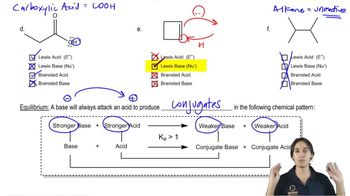
Equilibrium constant and conjugates.

Alcohols and Their Protonation

Alcohols, like CH3CH2OH (ethanol), can act as weak acids. When they are protonated, they form their conjugate acids, which are typically oxonium ions. This concept is important for understanding the reactivity of alcohols in various chemical reactions, including their role in nucleophilic substitutions and eliminations.
추천 영상:
01:01
How to name alcohols

Alkoxide Ions

Alkoxide ions, such as CH3CH2O− (ethoxide), are the conjugate bases of alcohols. They are formed when an alcohol donates a proton. Recognizing the properties and reactivity of alkoxide ions is essential for understanding their role in organic synthesis, particularly in reactions involving nucleophiles and bases.
추천 영상:
가이드 코스
3:39
Metal Ion Catalysis Concept 1