


Ch. 2 - Acids and Bases: Central to Understanding Organic Chemistry
Bruice - Organic Chemistry 8th Edition
Bruice8th EditionOrganic ChemistryISBN: 9780135213711당신이 사용하는 게 아니라요?교과서 변경
2장, 문제 34c,d

For each of the following compounds, indicate the atom that is protonated when an acid is added to a solution of the compound.
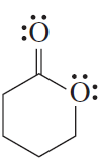
c. Chemical structure showing a compound with an oxygen atom, indicating the site of protonation when an acid is added.
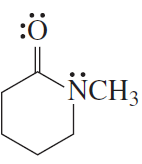
d. Chemical structure showing a hexagonal ring with an amine group and an oxygen atom, indicating protonation sites.

검증된 단계별 안내
1
Step 1: Analyze the structure of compound A. It contains a carbonyl group (C=O) and an ether oxygen atom. The ether oxygen has lone pairs of electrons, making it a likely site for protonation when an acid is added.
Step 2: Consider the structure of compound B. It contains a carbonyl group (C=O) and an amine group (-NH). The nitrogen atom in the amine group has lone pairs of electrons, making it a likely site for protonation when an acid is added.
Step 3: Recall that protonation occurs at the atom with the highest electron density or lone pairs that can interact with the proton (H⁺). In compound A, the ether oxygen is the most likely site for protonation due to its lone pairs.
Step 4: In compound B, the nitrogen atom in the amine group is the most likely site for protonation because nitrogen is more basic than oxygen and readily accepts a proton.
Step 5: Summarize the findings: For compound A, the ether oxygen is protonated. For compound B, the nitrogen in the amine group is protonated.

비슷한 문제에 대한 검증된 영상 답변:

이 영상 해법은 위 문제에 도움이 된다고 튜터들이 추천한 것입니다.
영상 길이:
3m

주요 개념

질문에 올바르게 답하기 위해 반드시 이해해야 하는 핵심 개념들은 다음과 같습니다.

Protonation

Protonation is the addition of a proton (H⁺) to a molecule, which can significantly alter its chemical properties. In organic chemistry, this process often occurs in the presence of acids, where the proton attaches to a site on the molecule that has a lone pair of electrons, typically resulting in a positively charged species. Understanding which atom is protonated helps predict the behavior of the compound in reactions.
추천 영상:
03:
Proton Splitting

Acid-Base Chemistry

Acid-base chemistry involves the transfer of protons between species, where acids donate protons and bases accept them. This concept is fundamental in organic reactions, as the nature of the acid and the basicity of the functional groups in the compounds dictate the site of protonation. Recognizing the acidic and basic sites in a molecule is crucial for predicting the outcome of acid-base reactions.
추천 영상:
02:49
The Lewis definition of acids and bases.

Functional Groups

Functional groups are specific groups of atoms within molecules that are responsible for the characteristic chemical reactions of those molecules. In the context of the provided compounds, identifying functional groups such as alcohols, amines, or carbonyls is essential, as they influence the site of protonation. Each functional group has distinct properties that determine its reactivity in acid-base chemistry.
추천 영상:
02:36
Identifying Functional Groups