

Ch. 2 - Acids and Bases: Central to Understanding Organic Chemistry
Bruice - Organic Chemistry 8th Edition
Bruice8th EditionOrganic ChemistryISBN: 9780135213711당신이 사용하는 게 아니라요?교과서 변경
2장, 문제 67

From which of the following compounds can HO− remove a proton in a reaction that favors product formation?
Chemical structures of four compounds labeled A to D, questioning which can lose a proton in a reaction favoring products.

검증된 단계별 안내
1
Step 1: Understand the concept of acidity and basicity. Hydroxide ion (HO⁻) acts as a base and can remove a proton (H⁺) from a compound if the compound has an acidic proton. The reaction will favor product formation if the resulting conjugate base is more stable than the original base.
Step 2: Evaluate the acidity of the compounds provided. Look for factors that increase acidity, such as electronegativity of the atom bonded to the proton, resonance stabilization of the conjugate base, and inductive effects from electronegative groups.
Step 3: Compare the pKa values of the compounds. A lower pKa value indicates a stronger acid, meaning the compound is more likely to donate a proton to HO⁻. If the pKa of the compound is significantly lower than the pKa of water (15.7), the reaction is likely to favor product formation.
Step 4: Analyze the stability of the conjugate base formed after the proton is removed. Stability can be enhanced by resonance, inductive effects, or the presence of electronegative atoms. If the conjugate base is stable, the reaction will favor product formation.
Step 5: Determine which compound has the most acidic proton based on the above factors. The compound with the most acidic proton will be the one from which HO⁻ can remove a proton in a reaction that favors product formation.

비슷한 문제에 대한 검증된 영상 답변:

이 영상 해법은 위 문제에 도움이 된다고 튜터들이 추천한 것입니다.
영상 길이:
5m

주요 개념

질문에 올바르게 답하기 위해 반드시 이해해야 하는 핵심 개념들은 다음과 같습니다.

Acidity and Basicity

Acidity refers to the tendency of a compound to donate protons (H+ ions), while basicity is the ability to accept protons. In organic chemistry, the strength of an acid is often measured by its pKa value; lower pKa values indicate stronger acids. Understanding the relative acidity of compounds is crucial for predicting which can be deprotonated by hydroxide ions (HO−) in a reaction.
추천 영상:
06:21
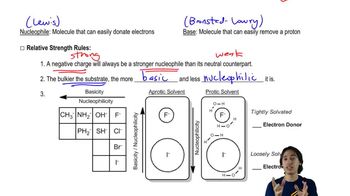
Understanding the difference between basicity and nucleophilicity.

Equilibrium and Reaction Favorability

Chemical reactions reach a state of equilibrium where the rate of the forward reaction equals the rate of the reverse reaction. The position of equilibrium is influenced by the stability of the products and reactants. A reaction favors product formation when the products are more stable than the reactants, often determined by factors such as bond strength and sterics.
추천 영상:
04:00
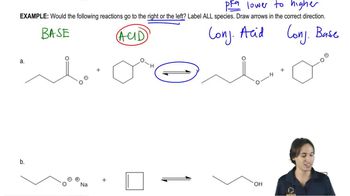
Determining Acid/Base Equilibrium

Proton Transfer Reactions

Proton transfer reactions involve the transfer of a proton from an acid to a base. In the context of the question, HO− acts as a base that can remove a proton from an acidic compound. The ability of HO− to effectively remove a proton depends on the acidity of the compound in question and the stability of the resulting conjugate base.
추천 영상:
03:
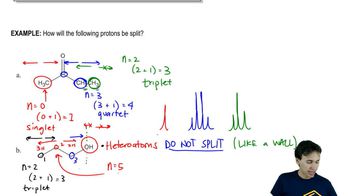
Proton Splitting
관련 실천
교과서 질문

Tenormin, a member of the group of drugs known as beta-blockers, is used to treat high blood pressure and improve survival after a heart attack. It works by slowing down the heart to reduce its workload. Which atom in Tenormin is the most basic?

1136
views
교과서 질문

For each of the following pairs of reactions, indicate which one has the more favorable equilibrium constant (that is, which one most favors products):

1.

2.

1218
views
교과서 질문

b. Determine the exact pKa values, using a calculator.

c. Which is the strongest acid?

1. nitrous acid (HNO2), Ka = 4.0 × 10⁻⁴

2. nitric acid (HNO3), Ka = 22

3. bicarbonate (HCO3−), Ka = 6.3 × 10⁻¹¹

4. hydrogen cyanide (HCN), Ka = 7.9 × 10⁻¹⁰

5. formic acid (HCOOH), Ka = 2.0 × 10⁻⁴

6. phosphoric acid (H3PO4), Ka = 2.1

1528
views
교과서 질문

Given the Ka values, estimate the pKa value of each of the following acids without using a calculator (that is, is it between 3 and 4, between 9 and 10, and so on?):

1. nitrous acid (HNO2), Ka = 4.0 × 10⁻⁴

2. nitric acid (HNO3), Ka = 22

3. bicarbonate (HCO3−), Ka = 6.3 × 10⁻¹¹

4. hydrogen cyanide (HCN), Ka = 7.9 × 10⁻¹⁰

5. formic acid (HCOOH), Ka = 2.0 × 10⁻⁴

6. phosphoric acid (H3PO4), Ka = 2.1

3087
views
교과서 질문

You are planning to carry out a reaction that produces protons. The reaction will be buffered at pH = 10.5. Would it be better to use a protonated methylamine/methylamine buffer or a protonated ethylamine/ethylamine buffer? (pKa of protonated methylamine = 10.7; pKa of protonated ethylamine = 11.0)

928
views
교과서 질문

Which of the four reactions has the most favorable equilibrium constant?

1.

1896
views