Ch. 20 - The Organic Chemistry of Carbohydrates
Bruice - Organic Chemistry 8th Edition
Bruice8th EditionOrganic ChemistryISBN: 9780135213711당신이 사용하는 게 아니라요?교과서 변경
20장, 문제 38a,b

Answer the following questions about the eight aldopentoses:
a. Which are enantiomers?
b. Which are C-2 epimers?

검증된 단계별 안내
1
Step 1: Understand the structure of aldopentoses. Aldopentoses are monosaccharides with five carbon atoms, including an aldehyde group at the C-1 position. The remaining carbons have hydroxyl groups attached, and the stereochemistry at the chiral centers determines the specific aldopentose.
Step 2: Define enantiomers. Enantiomers are pairs of molecules that are non-superimposable mirror images of each other. For aldopentoses, enantiomers will have opposite configurations at all chiral centers.
Step 3: Identify the eight aldopentoses. The eight aldopentoses include D-ribose, D-arabinose, D-xylose, D-lyxose, and their corresponding L-forms (L-ribose, L-arabinose, L-xylose, L-lyxose). Enantiomers are formed by pairing each D-form with its corresponding L-form.
Step 4: Define epimers. Epimers are stereoisomers that differ in configuration at only one chiral center. For C-2 epimers, the difference occurs specifically at the second carbon atom. Compare the stereochemistry at C-2 for each aldopentose to identify pairs that differ only at this position.
Step 5: Analyze the aldopentoses to determine C-2 epimers. For example, D-ribose and D-arabinose differ only at the C-2 position, making them C-2 epimers. Similarly, L-ribose and L-arabinose are C-2 epimers. Repeat this analysis for other pairs of aldopentoses to identify additional C-2 epimers.

비슷한 문제에 대한 검증된 영상 답변:

이 영상 해법은 위 문제에 도움이 된다고 튜터들이 추천한 것입니다.
영상 길이:
6m

주요 개념

질문에 올바르게 답하기 위해 반드시 이해해야 하는 핵심 개념들은 다음과 같습니다.

Aldopentoses

Aldopentoses are a class of monosaccharides that contain five carbon atoms and an aldehyde functional group. They are important in biochemistry and can exist in various stereoisomeric forms. The eight aldopentoses include ribose, arabinose, xylose, and lyxose, each differing in the arrangement of hydroxyl groups around the carbon skeleton.
추천 영상:
02:42
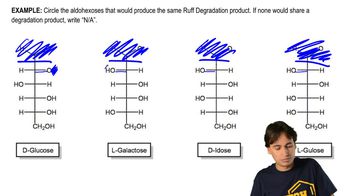
Which aldohexoses produce the same Ruff Degradation product

Enantiomers

Enantiomers are a type of stereoisomer that are non-superimposable mirror images of each other. They typically arise in molecules that have one or more chiral centers, leading to two distinct configurations. In the context of aldopentoses, identifying enantiomers involves recognizing pairs of sugars that differ at all chiral centers.
추천 영상:
03:23
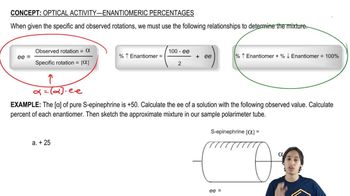
How to solve for the percentage of each enantiomer.

Epimers

Epimers are a specific type of diastereomer that differ in configuration at only one chiral center. In aldopentoses, C-2 epimers refer to sugars that have different configurations at the second carbon atom while remaining identical at all other chiral centers. Understanding epimerism is crucial for distinguishing between closely related sugars and their biological roles.
추천 영상:
03:42
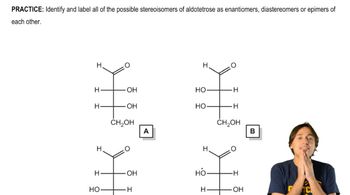
Identifying Types of Stereoisomers