Ch. 20 - The Organic Chemistry of Carbohydrates
Bruice - Organic Chemistry 8th Edition
Bruice8th EditionOrganic ChemistryISBN: 9780135213711당신이 사용하는 게 아니라요?교과서 변경
20장, 문제 5c

c. What sugar is the C-4 epimer of L-gulose?

검증된 단계별 안내
1
Understand the concept of epimers: Epimers are stereoisomers that differ in configuration at only one specific carbon atom, while the rest of the molecule remains identical. In this case, we are looking for the sugar that differs from l-gulose at the C-4 position.
Review the structure of l-gulose: l-Gulose is a six-carbon aldose sugar (an aldohexose). Its stereochemistry at each chiral center (C-2, C-3, C-4, and C-5) determines its identity. Draw the Fischer projection of l-gulose to visualize its configuration.
Identify the C-4 position: In the Fischer projection of l-gulose, locate the hydroxyl group (-OH) attached to the fourth carbon atom (C-4). Note its orientation (either on the left or right side of the projection).
Determine the epimer at C-4: To find the C-4 epimer, invert the configuration of the hydroxyl group at the C-4 position while keeping the configurations at all other chiral centers unchanged. This inversion creates a new sugar molecule.
Name the resulting sugar: After modifying the C-4 configuration, identify the name of the new sugar based on its stereochemistry. Compare the structure to known aldohexoses to determine its identity.

비슷한 문제에 대한 검증된 영상 답변:

이 영상 해법은 위 문제에 도움이 된다고 튜터들이 추천한 것입니다.
영상 길이:
1m

주요 개념

질문에 올바르게 답하기 위해 반드시 이해해야 하는 핵심 개념들은 다음과 같습니다.

Epimers

Epimers are a specific type of diastereomer that differ in configuration at only one stereogenic center. In the context of sugars, this means that two sugars can have the same molecular formula and differ only at one carbon atom's stereochemistry. Understanding epimers is crucial for identifying relationships between different sugars, such as determining which sugar is the C-4 epimer of another.
추천 영상:
03:42
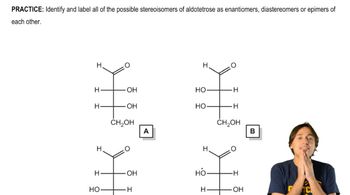
Identifying Types of Stereoisomers

D- and L- Configuration

The D- and L- notation refers to the configuration of sugars based on the orientation of the hydroxyl group (-OH) on the penultimate carbon (the second-to-last carbon). D-sugars have the hydroxyl group on the right in a Fischer projection, while L-sugars have it on the left. This classification is essential for distinguishing between different sugar forms and understanding their structural relationships.
추천 영상:
05:09
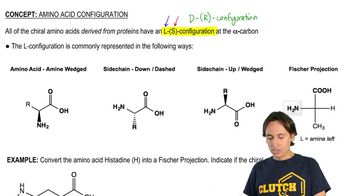
Representations of L-Configuration

Gulose

Gulose is a six-carbon sugar (hexose) that can exist in two forms: D-gulose and L-gulose. It is an aldohexose, meaning it contains an aldehyde group. Knowing the structure and stereochemistry of gulose is important for identifying its epimers, as well as for understanding its role in biological systems and its relationship to other sugars.
추천 영상:
08:09
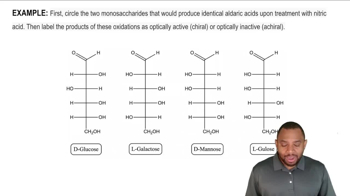
Which monosaccharides would produce aldaric acid?