
Ch. 20 - The Organic Chemistry of Carbohydrates
Bruice - Organic Chemistry 8th Edition
Bruice8th EditionOrganic ChemistryISBN: 9780135213711당신이 사용하는 게 아니라요?교과서 변경
20장, 문제 71

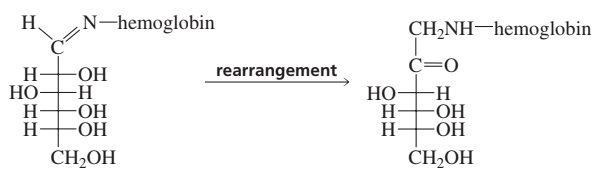
Propose a mechanism for the rearrangement that converts an ⍺-hydroxyimine to an ⍺-aminoketone in the presence of a trace amount of acid.
Mechanism showing the rearrangement of an α-hydroxyimine to an α-aminoketone with hemoglobin involvement.

검증된 단계별 안내
1
Step 1: Protonation of the hydroxyl group (-OH) on the α-hydroxyimine occurs in the presence of trace acid (H₃O⁺). This increases the electrophilicity of the carbon atom attached to the hydroxyl group, making it more susceptible to nucleophilic attack.
Step 2: The protonated hydroxyl group (-OH₂⁺) leaves as water (H₂O), generating a carbocation at the α-carbon. This carbocation is stabilized by resonance with the imine group.
Step 3: The lone pair of electrons on the nitrogen atom of the imine group migrates to form a double bond with the α-carbon, resulting in the formation of a new bond and shifting the positive charge onto the nitrogen atom.
Step 4: A molecule of water (H₂O) attacks the positively charged nitrogen atom, leading to the formation of an intermediate where the nitrogen is bonded to both the α-carbon and a hydroxyl group.
Step 5: Deprotonation of the hydroxyl group on the nitrogen occurs, resulting in the final product: an α-aminoketone, where the α-carbon is bonded to a ketone group and the nitrogen is bonded to a hydrogen atom.

비슷한 문제에 대한 검증된 영상 답변:

이 영상 해법은 위 문제에 도움이 된다고 튜터들이 추천한 것입니다.
영상 길이:
7m

주요 개념

질문에 올바르게 답하기 위해 반드시 이해해야 하는 핵심 개념들은 다음과 같습니다.

Hydroxyimine Structure

A-hydroxyimines are compounds containing a hydroxyl group (-OH) and an imine group (C=N) on adjacent carbon atoms. This structure is crucial for understanding the rearrangement mechanism, as the hydroxyl group can participate in protonation and subsequent reactions under acidic conditions, facilitating the conversion to an a-aminoketone.
추천 영상:
03:04
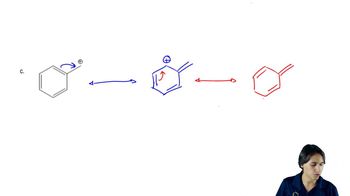
Drawing Resonance Structures

Protonation and Acid Catalysis

In the presence of a trace amount of acid, such as H3O+, protonation of the hydroxyl group occurs, enhancing its leaving ability. This step is essential in the mechanism, as it leads to the formation of a more reactive intermediate that can rearrange to form the a-aminoketone, demonstrating the role of acid catalysis in organic reactions.
추천 영상:
가이드 코스
2:50
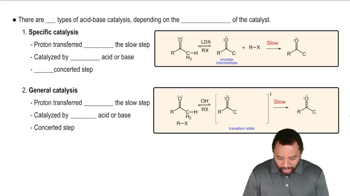
Acid-Base Catalysis Concept 3

Rearrangement Mechanism

The rearrangement mechanism involves the transformation of the a-hydroxyimine to an a-aminoketone through a series of steps, including protonation, loss of water, and reorganization of the double bond. Understanding this mechanism is vital for predicting the product and the reaction pathway, highlighting the importance of structural changes in organic synthesis.
추천 영상:
06:08
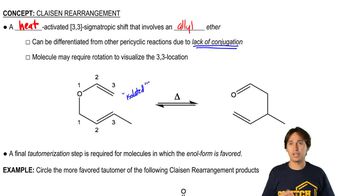
Definition of Claisen Rearrangement