Ch. 20 - The Organic Chemistry of Carbohydrates
Bruice - Organic Chemistry 8th Edition
Bruice8th EditionOrganic ChemistryISBN: 9780135213711당신이 사용하는 게 아니라요?교과서 변경
20장, 문제 39d

What is the configuration of each of the asymmetric centers in the Fischer projection of
d. D-xylose?

검증된 단계별 안내
1
Step 1: Understand the Fischer projection of D-xylose. D-xylose is a five-carbon aldose sugar with the aldehyde group (-CHO) at the top and the hydroxymethyl group (-CH2OH) at the bottom. The asymmetric centers are the carbons bonded to four different groups.
Step 2: Identify the asymmetric centers in D-xylose. These are the carbons in the middle of the Fischer projection that are bonded to a hydrogen atom, a hydroxyl group (-OH), and two other groups.
Step 3: Assign priorities to the substituents around each asymmetric center based on the Cahn-Ingold-Prelog (CIP) rules. The substituent with the highest atomic number gets the highest priority.
Step 4: Determine the configuration (R or S) of each asymmetric center. To do this, visualize the molecule in 3D, ensuring the lowest priority group (usually hydrogen) is pointing away from you. Trace the path of the remaining groups in order of priority (1 → 2 → 3). If the path is clockwise, the configuration is R; if counterclockwise, it is S.
Step 5: Repeat the process for each asymmetric center in D-xylose. Carefully analyze the Fischer projection to ensure the correct assignment of configurations for all chiral centers.

비슷한 문제에 대한 검증된 영상 답변:

이 영상 해법은 위 문제에 도움이 된다고 튜터들이 추천한 것입니다.
영상 길이:
9m

주요 개념

질문에 올바르게 답하기 위해 반드시 이해해야 하는 핵심 개념들은 다음과 같습니다.

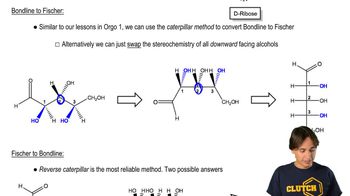
Fischer Projections

Fischer projections are a two-dimensional representation of three-dimensional organic molecules, particularly carbohydrates. In these projections, vertical lines represent bonds that extend away from the viewer, while horizontal lines indicate bonds that come towards the viewer. This format is particularly useful for visualizing the stereochemistry of molecules, especially those with multiple chiral centers.
추천 영상:
09:56
Monosaccharides - Drawing Fischer Projections

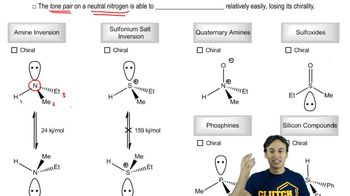
Chirality and Asymmetric Centers

Chirality refers to the property of a molecule that makes it non-superimposable on its mirror image, often due to the presence of asymmetric centers (chiral centers). Each asymmetric center in a molecule can exist in two configurations, typically designated as 'R' (rectus) or 'S' (sinister), based on the Cahn-Ingold-Prelog priority rules. Understanding chirality is crucial for determining the optical activity and biological interactions of molecules.
추천 영상:
05:41
Understanding Other Chiral Atoms

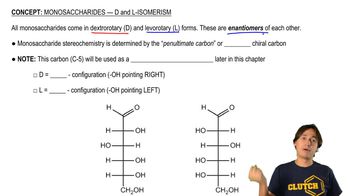
D and L Notation

The D and L notation is used to classify sugars based on the configuration of their asymmetric carbon furthest from the aldehyde or ketone group. In D-sugars, the hydroxyl group (-OH) on this carbon is on the right in the Fischer projection, while in L-sugars, it is on the left. This notation is essential for distinguishing between different stereoisomers of sugars, which can have vastly different biological functions.
추천 영상:
06:47
Monosaccharides - D and L Isomerism